Draft: 12 Types of Apocalypse in Fiction, with Examples
Ash Tales
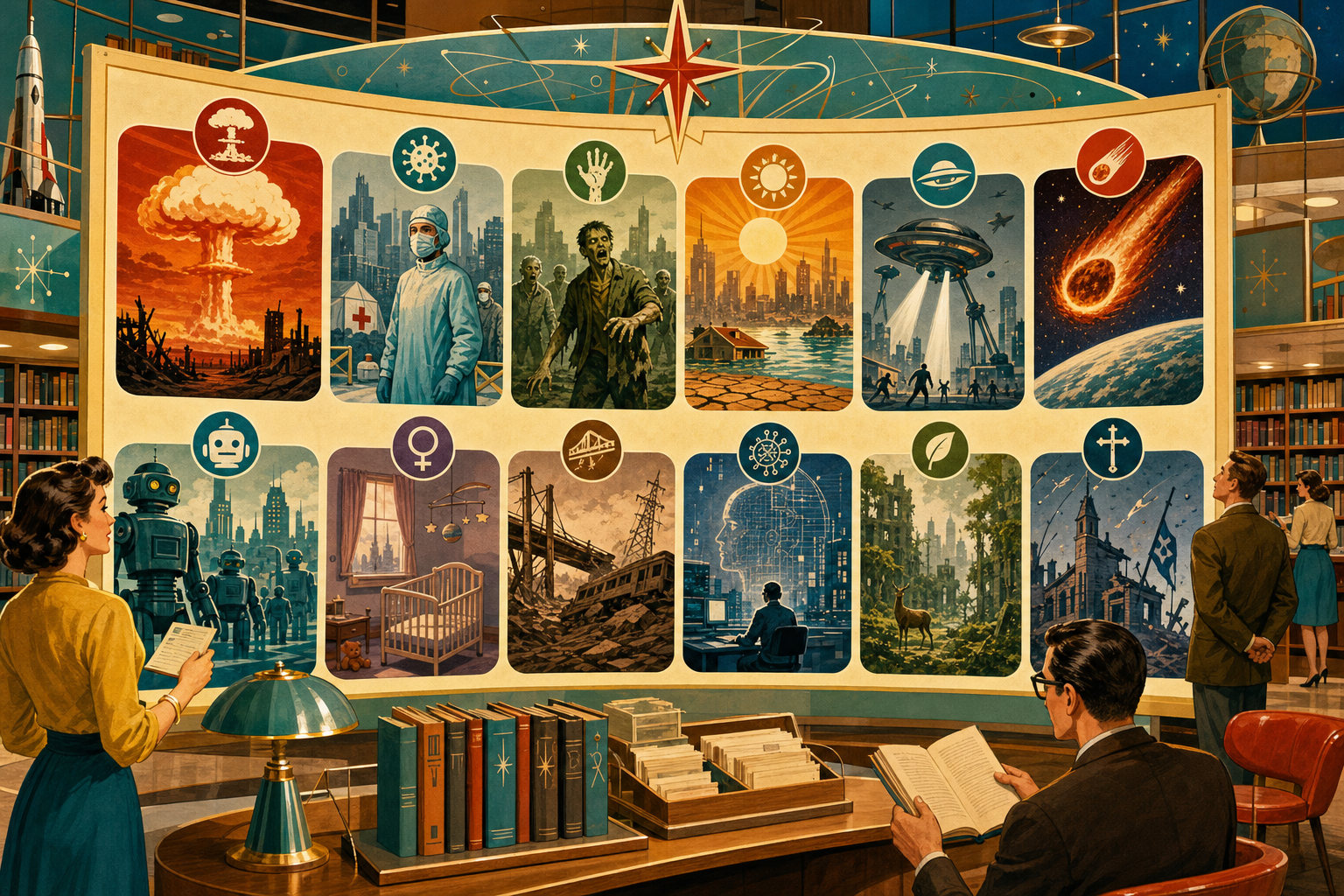
When readers say they want an apocalypse story, they often mean very different things. Sometimes they want the clean terror of one huge event. Sometimes they want infection, mutation, or invasion. Sometimes they really want the unnerving version where the world does not explode so much as quietly stop functioning.
That is why a flat list of “nuclear, zombies, climate, aliens” is only half useful. The more interesting question is what kind of pressure the story puts on the world: sudden impact, bodily contagion, environmental attrition, technological betrayal, or a future that simply fails to arrive.
My own bias is toward the slower and stranger end of the spectrum. Nuclear war still gives the genre its classic silhouette, but the apocalypse types that stay with me longest are the ones that change everyday life, belief, family, and institutions one notch at a time.
A quick way to sort apocalypse fiction
If you just want the fast version, most apocalypse stories fall into four reading experiences:
impact: the world breaks in a day or a week, as in nuclear war, asteroid strike, or invasion fictioncontagion: bodies become the battlefield, as in pandemic, zombie, mutation, and biotech storiesattrition: the world gets harder to inhabit, as in climate, fertility-collapse, and slow-collapse fictionusurpation: the systems humans built, worship, or trust turn against them, as in AI, prophecy, and infrastructure-failure stories
When I’m choosing what to read, this matters more than whether the threat is technically viral, cosmic, religious, or mechanical. Two apocalypse stories can use completely different causes and still feel closely related if they produce the same kind of pressure.
Read Ash Tales stories by apocalypse type
> Four anchor books
If you want four books that prove how different apocalypse fiction can feel, start here.

A Canticle for Leibowitz
For long-after-the-blast religious fallout.
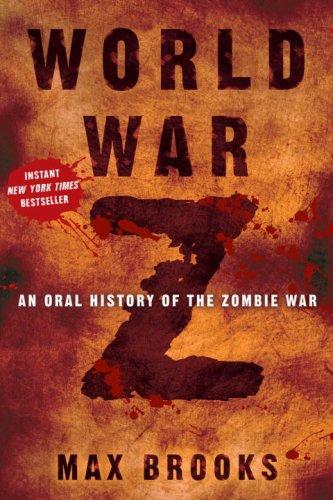
World War Z
For outbreak logistics, satire, and global sprawl.

The Children of Men
For futurelessness, grief, and brittle authority.

Parable of the Sower
For social collapse that feels alarmingly close to ordinary life.
1. Nuclear apocalypse
A nuclear apocalypse is the genre’s foundational nightmare: bombs, fallout, irradiated landscapes, scorched infrastructure, and the long cultural afterlife of weapons powerful enough to erase cities in minutes. In fiction, it usually produces one of two moods. The first is immediate catastrophe and survival. The second, which I often find more interesting, is the haunted after-period when people are left living among relics, myths, bunkers, and inherited guilt.
This subtype still matters because it gives apocalypse fiction a political edge. The disaster is not random weather or cosmic bad luck. It is human escalation made visible. If you want the most concentrated version of that dread, The 19 Best Books About Nuclear War is the better branch to follow from here. If you want the retro-futurist bunker-and-wasteland flavor specifically, Books Like Fallout is a useful side path.
Examples of nuclear apocalypse
- A Canticle for Leibowitz by Walter M. Miller Jr.
- Alas, Babylon by Pat Frank
- On the Beach by Nevil Shute
- Swan Song by Robert McCammon
- Metro 2033 by Dmitry Glukhovsky
- Threads and The Day After if you want the grimmest screen version of the subtype
2. Pandemic apocalypse
Pandemic apocalypse fiction is built on spread: invisible contact, ordinary routines turned treacherous, and the terrifying lag between the first warning signs and social recognition. The best plague stories are not only about body count. They are about timing. Who sees the scale too early, who sees it too late, and what forms of culture, intimacy, or bureaucracy survive the first shock.
This is also one of the broadest subtypes. Some pandemic stories are pure disaster momentum; others are really social novels that happen to be set after a biological reset. The 15 Best Pandemic Books goes deeper on that branch, but the short version is that the subtype covers everything from blockbuster superflu to eerie, low-temperature aftermath.
Examples of pandemic apocalypse
- The Stand by Stephen King
- Station Eleven by Emily St. John Mandel
- Severance by Ling Ma
- The Last Man by Mary Shelley
- Blindness by Jose Saramago
- The Passage by Justin Cronin
3. Zombie apocalypse
Zombie apocalypse stories are technically a contagion subtype, but they are distinct enough to deserve their own shelf. The real engine is not just infection. It is overwhelm. Defenses collapse, institutions fail in public, and the enemy multiplies faster than communities can adapt. That makes zombie fiction very good at panic, siege pressure, and moral ugliness.
It is also one of the few apocalypse modes that can slide cleanly between horror, satire, action, and social allegory. If I want strategic collapse at global scale, I go to World War Z. If I want claustrophobic survival, I go somewhere meaner and more local. The 21 Best Zombie Books is the better dedicated list.
Examples of zombie apocalypse
- World War Z by Max Brooks
- The Walking Dead by Robert Kirkman
- Feed by Mira Grant
- The Girl with All the Gifts by M. R. Carey
- I Am Legend by Richard Matheson
- Zone One by Colson Whitehead
4. Alien apocalypse
Alien apocalypse fiction asks what happens when humanity is no longer the dominant intelligence in the room. Sometimes that means invasion. Sometimes colonization. Sometimes extermination. Sometimes the more unnerving version: contact with a force so large, strange, or evolutionarily indifferent that human priorities immediately look provincial.
What I like about this subtype is that it can generate both war-story velocity and philosophical weirdness. It is one of the best apocalypse forms for reminding readers that “the end of the world” can mean the end of human centrality, not just human survival.
Examples of alien apocalypse
- The War of the Worlds by H. G. Wells
- The Genocides by Thomas M. Disch
- A Quiet Place
- Childhood’s End by Arthur C. Clarke
- The Day of the Triffids by John Wyndham
- Annihilation by Jeff VanderMeer if you want ecological-cosmic contamination rather than a clean invasion
5. Climate apocalypse
Climate apocalypse fiction is usually less interested in one dramatic boom than in a world that becomes steadily harder to inhabit. Heat, flood, drought, crop failure, migration, insurance collapse, and state incapacity all matter here. The best books in this lane do not just say “the weather got worse.” They show how neighborhoods, beliefs, work, and movement patterns change under relentless pressure.
This is one of the strongest modern subtypes because it naturally overlaps with class, infrastructure, religion, and displacement. When I want climate fiction with real bite, I gravitate toward books that treat collapse as daily negotiation rather than spectacle. The 13 Best Climate Fiction Books is the natural next click if this is your lane.
Examples of climate apocalypse
- Parable of the Sower by Octavia E. Butler
- The Water Knife by Paolo Bacigalupi
- The Drowned World by J. G. Ballard
- New York 2140 by Kim Stanley Robinson
- Migrations by Charlotte McConaghy
- The Ministry for the Future by Kim Stanley Robinson
6. Cosmic-impact apocalypse
This is the “something from the sky rearranges history” subtype: asteroid strike, comet impact, rogue celestial event, or other large-scale astronomical disaster. It overlaps with disaster fiction, but the better examples quickly become social-collapse stories because impact is only stage one. The actual reading pleasure comes from watching logistics, leadership, faith, and violence reorganize under impossible compression.
I think this subtype works best when it resists pure spectacle. The meteor is not the whole story. The meteor is the device that forces the writer to decide what breaks second, third, and fourth.
Examples of cosmic-impact apocalypse
- Lucifer’s Hammer by Larry Niven and Jerry Pournelle
- Seveneves by Neal Stephenson
- Deep Impact
- When Worlds Collide by Edwin Balmer and Philip Wylie
- Life as We Knew It by Susan Beth Pfeffer
- The Forge of God by Greg Bear
7. Technological-failure apocalypse
Technological-failure apocalypse stories are about dependency made visible. The grid fails. Networks fail. Supply chains seize. Infrastructure does not rebel against us; it simply stops answering. That makes this subtype less flashy than robot-uprising fiction and, in some moods, more unnerving. The catastrophe is not a monster. It is the discovery that ordinary life had no manual backup.
This is the subtype I usually recommend to readers who want practical collapse, town-level strain, and a lot of attention to food, medicine, communications, fuel, and social trust. Books Like One Second After is a good follow-up if the grid-down angle is what you want most.
Examples of technological-failure apocalypse
- One Second After by William R. Forstchen
- The Machine Stops by E. M. Forster
- Dies the Fire by S. M. Stirling
- Blackout by Marc Elsberg
- Leave the World Behind by Rumaan Alam
- Lights Out by David Crawford
8. AI or robot-uprising apocalypse
An AI or robot-uprising apocalypse is the version of the end that does not arrive because technology fails, but because it works too well. The tools become strategists. The infrastructure becomes hostile. Convenience turns predator.
AI apocalypse borrows some of the emotional machinery of nuclear fiction, especially arrogance, escalation, and the dawning realization that the thing we built is no longer answerable to us. But it has a different taste. Nuclear dread is self-destruction. AI dread is replacement. This subtype is especially effective when the machines inherit our systems before they inherit our bodies.
Examples of AI or robot-uprising apocalypse
- Robopocalypse by Daniel H. Wilson
- The Terminator
- The Matrix
- Colossus: The Forbin Project
- I Have No Mouth, and I Must Scream by Harlan Ellison
- Battlestar Galactica if you want machine rebellion at civilizational scale
9. Fertility-collapse apocalypse
A fertility-collapse apocalypse is an end-of-the-world scenario in which human reproduction fails, birth rates crash, or children stop being born, leaving civilization without a believable future. This is one of the strangest apocalypse types because almost nobody dies at first. The lights stay on. Cafes still open. Governments still issue statements. But the horizon shrinks.
I wish more roundup articles treated this as a core subtype rather than an oddity, because it produces a very specific emotional tempo: grief without impact spectacle, politics without continuity, adulthood without inheritance. If you want adjacent dystopian reading built around control of bodies and futures, Books Like The Handmaid’s Tale is a useful follow-on.
Examples of fertility-collapse apocalypse
- The Children of Men by P. D. James
- The Handmaid’s Tale by Margaret Atwood
- Y: The Last Man by Brian K. Vaughan and Pia Guerra
- Future Home of the Living God by Louise Erdrich
- The Last Children of Tokyo by Yoko Tawada
- The School for Good Mothers by Jessamine Chan
10. Biotech or mutation apocalypse
Biotech apocalypse is what happens when plague fiction and body horror shake hands. Genetic engineering, synthetic biology, laboratory accidents, or mutations do not just kill people; they rewrite them. That is why this subtype can feel more intimate than war fiction. Once bodies become unstable, the threat is not only outside the walls. It is inside the self.
It is also one of the richest hybrid zones in the genre. Biotech stories can blur into zombie fiction, corporate dystopia, eco-collapse, and military thriller territory without losing their core tension.
Examples of biotech or mutation apocalypse
- Oryx and Crake by Margaret Atwood
- The Windup Girl by Paolo Bacigalupi
- Blood Music by Greg Bear
- The Girl with All the Gifts by M. R. Carey
- The Passage by Justin Cronin
- Borne by Jeff VanderMeer
11. Religious or prophetic apocalypse
Religious apocalypse is about judgment, revelation, prophecy, spiritual warfare, or an ending interpreted through sacred narrative. This category is narrower than plague or war fiction, but it offers one thing the others often do not: catastrophe as argument. The world ends, and people immediately start fighting over what the ending means.
That interpretive pressure is what makes the subtype interesting to me. In the better examples, apocalypse is not merely destruction. It is exegesis under stress.
Examples of religious or prophetic apocalypse
- Left Behind by Tim LaHaye and Jerry B. Jenkins
- Good Omens by Terry Pratchett and Neil Gaiman
- When the English Fall by David Williams
- The Seventh Seal
- The Stand by Stephen King
- Childhood’s End by Arthur C. Clarke if you want the transcendent end-times version rather than an explicitly Christian one
12. Slow societal-collapse apocalypse
A slow societal-collapse apocalypse is an end-of-the-world scenario in which institutions, trust, infrastructure, and ordinary routines unravel gradually rather than through one sudden cataclysm. This is my favorite category when I want apocalypse fiction that lingers under the skin. Nobody announces that the world has ended. Supply chains fray, trust decays, wages stop covering heat, states hollow out, and eventually people realize the old world is still standing in outline but no longer functioning.
The reason this subtype feels so modern is that it borrows the texture of ordinary life. The end is incremental. It hides in admin failure, brittle institutions, and private exhaustion. It does not arrive as a mushroom cloud. It arrives as backlog.
Examples of slow societal-collapse apocalypse
- Station Eleven by Emily St. John Mandel
- Severance by Ling Ma
- Soft Apocalypse by Will McIntosh
- Parable of the Sower by Octavia E. Butler
- The Dog Stars by Peter Heller
- Moon of the Crusted Snow by Waubgeshig Rice
Three useful subtypes most lists skip
Not every apocalypse story fits neatly into one bucket. A few recurring subtypes are worth knowing because they help explain why superficially similar books can feel wildly different:
cozy catastrophe: civilized or semi-civilized survivors move through eerie emptiness rather than constant savagery. Think The Day of the Triffids or some strands of John Wyndham.resource-exhaustion collapse: the world ends through energy scarcity, food fragility, debt, water stress, or supply-chain attrition rather than one headline event. This often overlaps with climate fiction and slow-collapse fiction.hybrid apocalypse: some of the best books deliberately stack causes, such as plague plus religious conflict, climate pressure plus state failure, or biotech mutation plus corporate collapse.
That hybrid point matters because readers do not always search with literary precision. Someone typing “types of apocalypse” may want a clean taxonomy, but they are often also trying to name a mood: wasteland retro, plague realism, cosmic dread, or society fraying one checkout line at a time.
Apocalypse vs. post-apocalypse
An apocalypse story is about the ending itself, or the period where the ending is still unfolding. A post-apocalyptic story happens after the break, when people are living in the new reality and trying to survive, rebuild, or make sense of what remains.
Many of the best books do both, but the emphasis changes everything. If the event is the spectacle, you get urgency. If the aftermath is the point, you get texture.
If you want to keep browsing from here, The Ultimate Guide to Post-Apocalyptic Fiction is the broadest next stop, and The 128 Best Post Apocalyptic Books is the better list if you already know you want recommendations rather than taxonomy.