Books Like I Who Have Never Known Men: 7 Bleak Literary Apocalypses
The Ultimate Guide to Post-Apocalyptic Fiction
Jacqueline Harpman’s I Who Have Never Known Men removes so many familiar things that the absences start to feel physical. A group of women is held underground by silent guards. The youngest remembers no life before captivity, does not know why they are imprisoned, and has no ordinary experience of family, desire, society, or the world outside. Then the guards disappear and the door opens.
Many post-apocalyptic novels run on explanation. Harpman’s novel runs on the refusal of it. The women gain space, time, and practical freedom, but answers never arrive to turn their suffering into a tidy plot. What remains is the harder material: how a person becomes human without a normal past, what freedom means when there may be nobody left to meet, and whether a life needs witnesses in order to matter.
That is why this list leans literary and existential. These books match the mysterious aftermath, female isolation, captivity, stripped-down survival, withheld knowledge, or the cold pressure of continuing in a world that may never explain itself. A few are more plot-driven than Harpman. None is here merely because it contains a bunker.
Best Books Like I Who Have Never Known Men at a Glance
- Closest isolated-young-woman survival match: Z for Zachariah
- Best for an unnamed woman crossing a gendered aftermath: The Book of the Unnamed Midwife
- Best for absolute existential bleakness: The Road
- Best for captivity, withheld knowledge, and quiet tragedy: Never Let Me Go
- Best for women preserving memory after catastrophe: A Gift Upon the Shore
- Best for feminist dystopia and institutional control: Daughters of the North
- Best classic for plague, solitude, and the last witness: The Last Man
> Ryan's quick-start picks
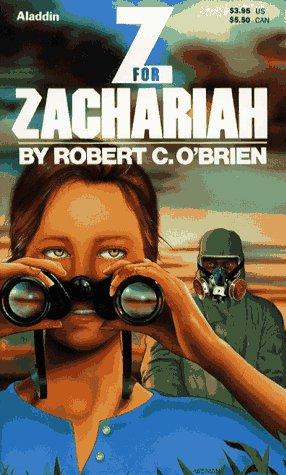
Z for Zachariah
Start here for another young woman testing freedom, danger, trust, and isolation in a nearly empty world.

The Book of the Unnamed Midwife
Start here for an unnamed female survivor whose movement through the aftermath is shaped by bodily risk and the record she leaves behind.

Never Let Me Go
Start here if captivity, incomplete explanations, and lives quietly constrained by an institution mattered more than practical survival.
Z for Zachariah by Robert C. O’Brien
Ann Burden believes she may be the only survivor of nuclear war, living alone in a valley protected from fallout. Her routines are practical and self-contained until another survivor arrives, bringing the possibility of companionship and the possibility that solitude was safer.
O’Brien explains more than Harpman and gives the story a clearer interpersonal threat, but the emotional overlap is strong. Both protagonists have to define freedom without a functioning society around them. Both discover that another human presence does not automatically solve loneliness, and that survival can require protecting an inner life as fiercely as food or shelter.
Read this when the open landscape, the uncertainty of being alone, and the question of whether trust is worth its risks mattered most.
The Book of the Unnamed Midwife by Meg Elison
A plague devastates humanity and kills women in disproportionate numbers. An unnamed midwife moves through the remains of the United States, often disguised as a man, offering medicine and contraception while recording communities shaped by scarcity, violence, and reproductive power.
This is a much more practical and confrontational book than Harpman’s. The threat has an explanation, the survivor has specialist knowledge, and the world contains many other people. The connection lies in namelessness, gender, bodily autonomy, and the act of constructing a self after the old social vocabulary has collapsed.
Harpman’s narrator has never known the roles the other women lost. Elison’s narrator knows those roles too well and must keep negotiating which ones can safely be inhabited. Read them together for two sharply different versions of a woman moving through the aftermath without an identity the world can easily contain.
The Road by Cormac McCarthy
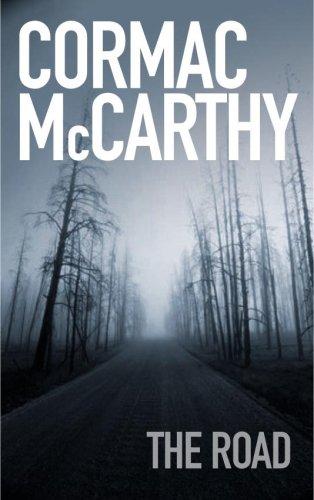
An unnamed father and son travel through an ash-covered world whose catastrophe is never explained. Food, shelter, weather, and other survivors provide immediate danger, but the novel’s real pressure comes from the attempt to keep moral meaning alive when the world no longer rewards it.
This is the closest match for Harpman’s refusal of explanation and her stripped-down existential landscape. Both novels withhold the reassuring architecture of a normal apocalypse story. Nobody discovers the secret facility, identifies the cause, or reaches a settlement where the plot finally makes sense.
McCarthy is more violent and places love between parent and child at the center. Harpman is colder, more solitary, and more interested in a person who must invent humanity without receiving that inheritance. If you want the same unanswered emptiness with a more immediate emotional bond, read this next, then continue to Books Like The Road.
Never Let Me Go by Kazuo Ishiguro
Kathy remembers growing up at Hailsham, a secluded school whose students gradually understand that their lives have been designed for a purpose the adults around them refuse to state plainly. Friendship, jealousy, art, rumor, and institutional euphemism fill the space where honest explanation should be.
There is no apocalypse here, but the emotional machinery is uncannily compatible. Both books follow people raised inside confinement who lack ordinary reference points for the lives denied to them. Knowledge arrives partially, too late, or not at all. The institution’s silence becomes a form of control, and the characters must decide what dignity means inside boundaries they did not choose.
Ishiguro is warmer and more socially detailed, yet just as devastating in his restraint. Choose this if the bunker and guards interested you less than the psychological consequences of growing up without access to a normal human future.
A Gift Upon the Shore by M. K. Wren
After nuclear war and disease, two women on the Oregon coast attempt to preserve books, memory, and a record of the civilization that has vanished. Their work becomes more urgent as another community’s authoritarian beliefs threaten what can be remembered and transmitted.
Harpman’s narrator lacks cultural inheritance almost completely. Wren’s survivors understand that loss and make preservation their central responsibility. Read together, the novels illuminate opposite ends of the same problem: what a person becomes without shared history, and why keeping a record matters even when the future audience is uncertain.
This is a more hopeful and communal book, but it shares the austere coastal quiet, the female perspective, and the sense that testimony may be the final meaningful gift one life can offer another.
Daughters of the North by Sarah Hall

In a near-future Britain shaped by state control and restrictions on women’s bodies, a woman leaves the regulated life assigned to her and seeks an alternative community in the north. Escape promises autonomy, but no collective project is free from power, compromise, or danger.
This is the most explicitly political recommendation here. Harpman strips the state almost completely from view, leaving only guards, rules, and the psychological fact of captivity. Hall keeps the machinery visible and asks how resistance communities reproduce or reject the systems they oppose.
Read it when the all-female prisoner group, bodily regulation, and the uneasy transition from confinement to self-rule were the elements you wanted expanded into a recognizably social world.
The Last Man by Mary Shelley

Mary Shelley’s plague novel follows Lionel Verney as political hopes, friendships, families, and nations disappear under the pressure of disease. Its scale is large, but its destination is the same terrible singularity announced by the title: one consciousness left carrying the memory of a vanished species.
The route is almost opposite to Harpman’s. Shelley begins with a richly populated social world and takes it away piece by piece. Harpman’s narrator begins after almost everything has already been removed and can only infer what human life once contained. Both ultimately ask what remains of identity when no community is available to confirm it.
This is slower, older, and far more Romantic in style. It belongs here for readers willing to follow the idea of the last witness back toward one of its earliest literary forms.
Where I Would Send Different Readers Next
- If you want the closest isolated-young-woman survival story, read Z for Zachariah.
- If you want an unnamed female survivor in a harsher, populated aftermath, read The Book of the Unnamed Midwife.
- If you want the unanswered apocalypse and absolute bleakness, read The Road.
- If you want captivity and withheld knowledge without an apocalypse, read Never Let Me Go.
- If you want women preserving memory for an uncertain future, read A Gift Upon the Shore.
- If you want the feminist political system made visible, read Daughters of the North.
- If you want a classic meditation on becoming the final witness, read The Last Man.