Books Like Silo and Wool: 7 Underground Post-Apocalyptic Worlds
The Best Post-Apocalyptic Book Series
The best thing about Hugh Howey’s Wool is not simply that everyone lives underground. It is that the silo feels engineered as a complete explanation of reality. Work, law, class, family, punishment, history, and even the desire to look outside have all been folded into one vertical system. Pull at a single rule and the whole world starts sounding hollow.
That is the real search intent behind books like Silo and Wool. Readers are usually after more than bunkers. They want sealed societies, poisoned exteriors, dangerous curiosity, lost history, maintenance as politics, and protagonists who discover that the institution keeping everyone alive may also be the thing keeping them trapped.
I built this list around those pressures. Some recommendations match the underground claustrophobia. Some are stronger on forbidden knowledge or engineered social order. Others widen the lens into far-future worlds where people live inside systems built by ancestors whose purpose has become myth.
The Silo trilogy itself continues through Shift and Dust, so read those before looking for a substitute if you have only finished Wool. The books below are for the point after that, when you still want another closed world with a locked door somewhere inside its official story.
Best Books Like Silo and Wool at a Glance
- Closest underground-society match: Metro 2033
- Best for bunker claustrophobia and nuclear command logic: Level 7
- Best for controlled knowledge after nuclear war: A Canticle for Leibowitz
- Best for a society that fears forbidden technology: The Long Tomorrow
- Best for history collapsing into ritual and myth: Riddley Walker
- Best for another protected settlement with a buried origin: The Passage
- Best deep cut for decayed technology mistaken for magic: The Book of the New Sun
> Ryan's quick-start picks

Metro 2033
Start here for the nearest combination of underground factions, dangerous tunnels, surface terror, and enclosed-world politics.
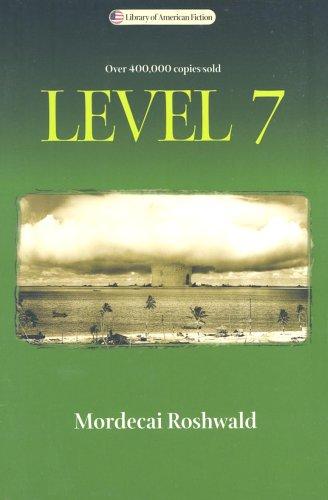
Level 7
Start here for the tightest nuclear-bunker pressure and the cold logic of people reduced to functions inside a sealed system.

A Canticle for Leibowitz
Start here if forbidden history, institutional memory, and who controls old knowledge mattered more than the physical silo.
Metro 2033 by Dmitry Glukhovsky
After nuclear war makes the surface lethal, survivors turn the Moscow Metro into a network of stations that function like tiny states. Artyom’s journey carries him through ideological enclaves, military powers, cults, traders, haunted tunnels, and communities held together by stories about what waits beyond their lights.
The resemblance to Wool is immediate, but the shape is different. Howey builds one vertically integrated society and lets a mystery climb through it. Glukhovsky builds a fractured underground map and sends his protagonist across its borders. Both understand that sealed survival spaces manufacture politics as efficiently as they recycle air.
If you want the bunker, the factions, the dangerous outside, and the possibility that official explanations are incomplete, this is the cleanest handoff. Continue with Books Like Metro 2033 if this is your lane.
Level 7 by Mordecai Roshwald
A military officer identified by a functional code rather than a name is assigned deep underground, where his role is to help launch nuclear retaliation and remain sealed away from the world the weapons will destroy. The bunker is ordered, procedural, and designed to turn human beings into reliable parts of a system.
This is much smaller and colder than Silo. There is no sprawling conspiracy adventure, but there is the same suffocating sense that architecture has become ideology. Every deeper level corresponds to greater protection, greater authority, and greater separation from ordinary life. Safety and imprisonment are almost impossible to distinguish.
Read it if the rules, surveillance, labor assignments, and punitive logic of Howey’s silo were more gripping than the surface mystery.
A Canticle for Leibowitz by Walter M. Miller Jr.
Centuries after nuclear war, monks preserve fragments of old knowledge through cycles of recovery, misunderstanding, political power, and renewed technological ambition. The world is not physically sealed like the silo, but history is compartmentalized just as fiercely.
Howey and Miller are both interested in what institutions tell later generations about the catastrophe that created them. In Wool, access to the past is a threat to the present order. In Canticle, preservation can become ritual long before anyone understands what the preserved material means. Knowledge is both salvation and the seed of another disaster.
This is the recommendation for readers fascinated by the Pact, deleted history, and the way a survival system edits collective memory to keep functioning. It is slower, stranger, and much more theological, but the civilizational question is the same.
The Long Tomorrow by Leigh Brackett
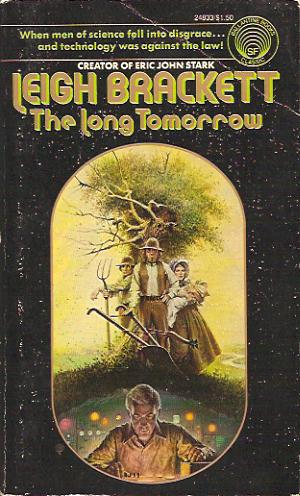
After nuclear war, constitutional limits prevent large settlements and organized technological development. Two young men raised in a rural religious community become obsessed with the forbidden remnants of scientific life and set out in search of a place rumored to preserve them.
This is a strong Silo companion because curiosity itself becomes political. The adults believe old technology nearly destroyed humanity and must remain constrained. The younger generation experiences that caution as a cage built from fear. The conflict is not simply progress versus ignorance; it is a genuine argument over whether survival requires suppressing the thing people most want to recover.
Brackett trades underground corridors for an open but socially restricted America. The match lies in the rule nobody is supposed to question and the suspicion that somewhere, hidden from view, another version of civilization has survived.
Riddley Walker by Russell Hoban

Long after nuclear catastrophe, a young man lives in an England where language, history, religion, and technical memory have mutated together. Pieces of the old world persist, but their meanings have been broken and rebuilt into performance, superstition, and political control.
This is what Silo’s memory problem looks like after many more generations. Howey’s characters still inhabit a functioning technological system whose history has been deliberately hidden. Hoban’s characters inhabit the distant result: a culture where the hiding, forgetting, and misreading have become the only available reality.
The prose demands more work than anything else here, but that work is the point. Reading the book feels like trying to reconstruct a forbidden past from damaged records, exactly the intellectual pleasure that drives the strongest parts of Wool.
The Passage by Justin Cronin
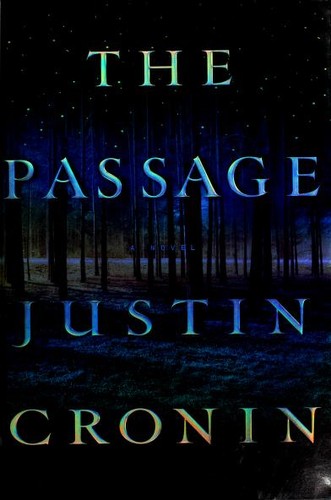
Cronin begins with the experiment that ends the old world and later moves into a fortified colony whose lights, routines, walls, and founding story have protected generations from what waits outside. Like Howey, he lets the settlement feel normal before revealing how fragile its normality is.
The physical match is looser because much of The Passage happens above ground and the threat is viral rather than nuclear. The social match is strong: an enclosed community built around inherited rules, critical infrastructure, fading knowledge, and a danger most inhabitants understand only through institutional memory.
Read this if you want Silo’s protected-society tension expanded into a much larger outbreak epic with monsters, journeys, and a longer historical horizon.
The Book of the New Sun by Gene Wolfe
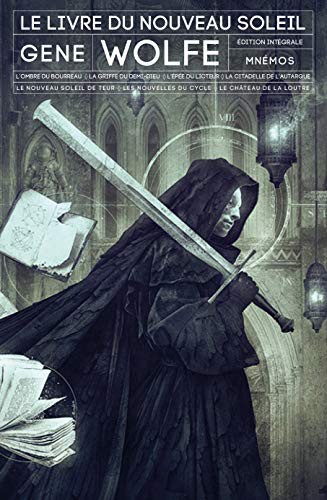
In Earth’s remote future, Severian travels through a civilization so old and layered that advanced technology, religious symbolism, decaying institutions, and medieval-seeming social orders occupy the same landscape. The reader is constantly seeing more than the narrator fully explains.
This is the deep-cut recommendation for the pleasure of living inside a system whose true age and purpose are difficult to read. Wolfe does not give you a tidy bunker mystery. He gives you a whole world built from forgotten machinery and inherited roles, then makes interpretation part of the story.
If Wool hooked you by making stairs, screens, cleaning rituals, and maintenance departments feel like clues to a larger buried design, Wolfe offers that sensation at civilizational scale. It is denser and far less direct, but few books are better at making lost technology feel like theology.
Where I Would Send Different Silo Readers Next
- If you want the closest underground-world follow-up, read Metro 2033.
- If you want pure bunker claustrophobia, read Level 7.
- If you want controlled history and institutional knowledge, read A Canticle for Leibowitz.
- If you want another society afraid of rediscovering technology, read The Long Tomorrow.
- If you want history transformed into language and myth, read Riddley Walker.
- If you want a large protected-settlement epic, read The Passage.
- If you want the most difficult and rewarding lost-technology world, read The Book of the New Sun.