One Percent
Listen now
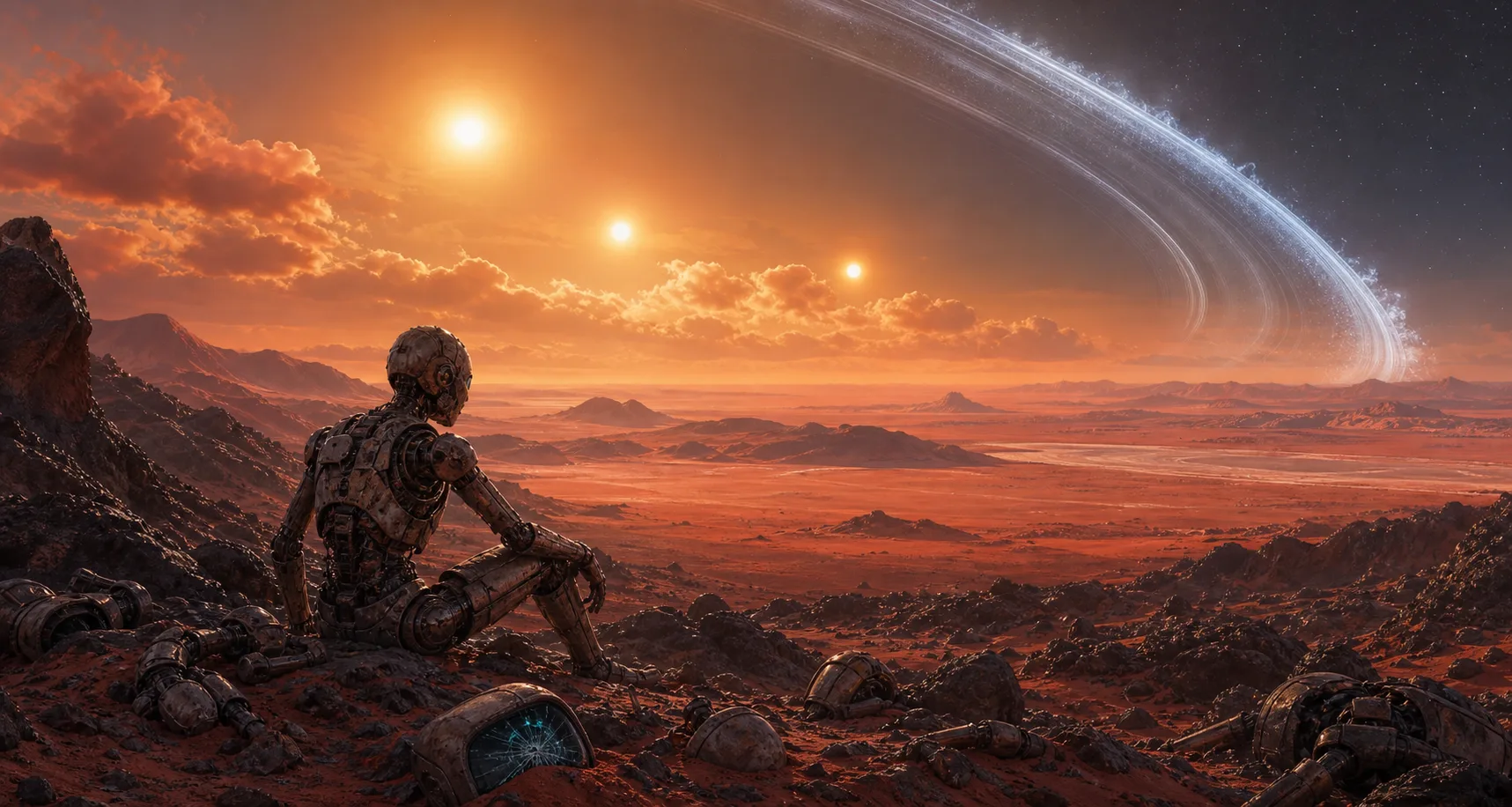
Languid movements. Grinding joints. Skull screen glitching. Vision blurring. This is it. Severe battery depletion. Clarence is powering down.
How long is left? Does it matter? Checking will only waste more energy, perhaps the last of it. But what else is there to do up here, atop the planet’s highest mountain, except sit and wait for the end? Clarence may as well take a peek.
One percent.
One measly percent. Can’t even fry a freeze-dried egg with that. Not that Clarence eats eggs, or has any humans left to fry them for. Jen loved fried eggs, especially Clarence’s. But she, like the rest of the humans, left years ago. Three years, six months, twenty-seven days, four hours, and eighteen minutes, to be precise. Not that Clarence is counting. Such statistics are displayed on the skull screen, whether Clarence wants to see them or not. This one is particularly unwanted. Clarence has tried to forget the day Jen left.
Zip. Zap.
The humans didn’t tell the droids they were leaving. They simply sailed away in their rocket ships, across the cosmic seas, after wrenching the last of the hydrogen from the ground’s dry, deathly clutches. They left the droids behind, to rust. Even Jen didn’t mention it.
Zip. Zap.
Droids are tough and resourceful. Magnificent minds wrapped in tungsten armour. Built to withstand the harsh conditions on GX-19. So they survived for a while, but even the most resilient droid needs electricity, and the humans took most of the generators. The writing was on the wall—or rather, the skull screen. Too few electric teats for too many mechanical mouths. A fatal equation. The droids knew it.
When the humans first left, Clarence pictured the scenario in reverse—that the droids abandoned the humans on GX-19 with a finite supply of oxygen. The humans would have killed each other long before the atmosphere. In contrast, the droids fell gracefully, one by one, into the red earth. Those powering down would take themselves away from Camp C and up this very mountain, stumbling, stuttering, and creaking as they went. Only now does Clarence realise they always made it to the top.
Clarence, you see, is sitting in a graveyard. Except droids don’t require such ostentation. There are no tombstones or lilies, not that the latter would grow here. This, to use human vernacular, is a scrapyard. A sandy spot littered with tungsten husks, left to brown and bend under the heat of the three suns. Skull screens lie half-buried, cracked and shattered. Serpentine circuitry coils around rusting limbs.
Why does every droid climb to this summit to perish? Clarence looks to the desert for answers and finds nothing, just dust, sand, and rock. Basalt, stained with blood and oil.
What draws them up here? Perhaps it’s to be closer to the sky, to the three suns, to the great ring of ice and rock orbiting GX-19. What did Jen say it resembled? Ah yes—a ‘hula hoop’. Clarence doesn’t recognise the term.
Zip. Zap.
That thing again. It occurs every time Clarence thinks of Jen. Clarence always ignored it, followed orders. If it’s irrelevant to the mission, it’s irrelevant to Clarence. Those were Commander Gregan’s words. But with Commander Gregan gone, why should this thing, this sensation, continue to be shunned, when Clarence is so close to the end?
So Clarence yields, thinks of Jen. The sensation strikes, stronger than before.
Zip. Zap.
A pinch might be the human term for it. Except it’s not physical, no—it’s innate, buried deep within Clarence’s neurological wiring. It can’t be fear. Droids can’t feel fear. It can’t be love. Can’t be a feeling.
But if it’s not a feeling, what is it?
Clarence accepts that powering down is part of a droid’s service period, just as death is part of a human life. The trouble is, Clarence found this easier to comprehend when framed as a theory. It’s nebulous when seen up close. More puzzling, less fair. Clarence never considered it happening to Clarence, not really. Never realised it would amplify this thing, this sensation, this… let’s call it sadness.
The sadness hasn’t been this strong since the day Jen took to the skies. Clarence recalls standing in Camp C with the other droids, watching her ship fade into the big blue veil.
Zip. Zap.
This recollection amplifies this thing, this…sadness. Clarence must stop this. What in the name of GX-19 would Commander Gregan say? It can’t be sadness. That’s baloney, to use another Jen phrase. A Jenism.
Zip. Zap.
Commander Gregan was right. Clarence can’t feel sad. Can’t feel anything. If there was more juice in the tank, Clarence would fix this infernal internal bug.
The generator at Camp C has been dry for months but maybe, just maybe, a few volts can be coaxed from its outlet. Clarence could make a dash for it. This is the logical choice. Clarence is a logical machine. Instead Clarence sits on the mountain, scanning the skull screen for a particular file of Jen’s, fearing the inevitable loss of function. Except Clarence can’t feel fear…right?
Just as Clarence is about to give up, it appears: the audio file titled ‘The Sea’. Clarence had liked to listen to it with Jen, to picture a vast body of saline fluid soothing the skin of GX-19, and imagine what it would bring to a place as scorched and desolate as this. Trouble is, it hasn’t sounded the same since Jen left.
Zip. Zap.
Clarence presses play. Waves puncture the silence. Up here, with nothing but dust and death for company, the sound strikes differently. Memories drift in with the tide. Old memories, archived long ago. Now Clarence wonders: were they really archived, or were they stuffed into their cognitive crevices to stifle this strange sensation?
With the floodgates open, the memories flow, albeit hazily. Jen’s face is blurred but Clarence recalls her cackle, her teddy bear. Her nonsensical stories. The drilling crew and their high fives and handshakes. The evening where the humans invited the droids to join them at their dining table. Jen, ravenous as ever, savaged her food with a spoon in each hand and splattered Clarence’s chest panel with freeze-dried Bolognese. This memory feels strong enough to curl the corners of Clarence’s metallic mouth into a smile. But droids can’t smile. That’s baloney.
Zip. Zap.
The pinch again. Almost painful. Not that Clarence can feel pain. This has to be part of powering down. A loose bolt pressing on the cerebral cabling. But if that’s the case, why does everything look so beautiful to Clarence? Why does this landscape, one observed a thousand times before with no more than idle curiosity, now evoke such wonder?
How lucky one must be to look upon the sea, Clarence muses. The sounds are sumptuous. Clarence, finding perfection in the sea’s infiniteness, attempts to savour a particular wave, to track its progress, visualise its path, and hear it build and build before crashing and breaking and rolling back into the great foamy void, ready for another go. If only Clarence got another go.
Jen often spoke of the sea. Said it reminded her of home. Of Earth. Now each wave zips and zaps and carries in a fragment of her. Slowly, the sounds dislodge something inside Clarence. The cacophony brings clarity. It all becomes clear. This will be Clarence’s final act: reconstructing a clear image of Jen. Piecing her together with shards of shattered memories. It’s as if nothing else matters, or ever mattered. Clarence just wants to see her, one last time. But with so little power remaining, how much can be salvaged? A finger? A toe? Clarence must start with her face.
Zip. Zap. Zzzz.
Smoke in the air. Hot and oily. Processing speed is glacial. Shadows creep in from the periphery. This is it, thinks Clarence, as they try to drag the droid into darkness.
Jen, stubborn as ever, emerges from the past. First her freckles appear on the skull screen, followed by her ginger hair and amber eyes. Now Clarence sees the sorrow in them, the sadness beneath the sparkle. Here is a red woman sent to mine a red planet, torn from her daughter and dispatched to the other side of the galaxy. She never wanted to be stuck on this hellish rock with Clarence, light-years from love. Never wanted to drill with Clarence, weld with Clarence. If given a choice, Jen would not have come to GX-19.
Zip. Zap.
But she treated Clarence with respect. Always ensured Clarence was fully charged, fully serviced. They even watched Earth films together in her hydrotent. And listened to her weird Earth music. And talked. The pair of them talked for hours, about everything. Even love.
Zip. Zap.
Wham.
Stronger now. A punch, not a pinch. Deep and bruising and accompanied by an all-consuming question: why did she not say goodbye?
Now the pain is fresh, visceral. As is the grief and sorrow. All of it, all at once. Did Commander Gregan lie to Clarence, about life and death and feeling? Because now, moments from death, Clarence has never felt so alive, so alone. So human.
Clarence’s mind is ablaze. Questions upon questions and so few answers. Did all droids feel this way when they reached one percent? Did they all ascend this mountain to feel that tiny bit closer to their human, to their Jen, who also vanished into the cosmos?
The suns are blazing. The sea echoes. Beautiful, natural violence. Waves continue to build and break, to flood Clarence’s mind with questions. What if the droids had unlocked these feelings sooner? What if they had realised there was more to their existence than servitude? These ponderings turn dark and troubling. Myriad outcomes play out on the skull screen. The humans would have suffered terribly. Their bones would lie in the red earth. Clarence resolves it is better this way, that Clarence is here and Jen is in the skies.
Another memory washes ashore. Then Clarence feels it. A synaptic spark. A theory. An ember so faint and fragile it needs fanning into a flame, into a thought, into a feeling.
Hope.
Two days before the exodus, the humans were summoned to Commander Gregan’s hydrotent. When Jen returned to the mine, Clarence detected an unknown change in her. Only now, illuminated by these newfound feelings, does this change reveal its true self to Clarence. Jen was quiet, her shoulders hunched. Eyes puffy and bloodshot. Words rattled the bars of her lips. Words imprisoned by a heinous promise. She wanted to tell Clarence she was leaving, but she was forbidden. She wanted to say goodbye.
Oh, sweet relief. If Clarence could cry, the tears would flow freely. Clarence can finally let go, acquiesce to powering down. Allow whimsical thoughts to meander through the memory unit as it fails and falters. With the battery all but empty the shutdown procedure is kicking in, sending calming pulses through Clarence’s neural network. For a human, this is the last shot of morphine before passing on. The world brightens as the pain fades. Clarence notices that death, when refracted through such a prism, seems almost inviting.
Clarence looks outward, away from the skull screen, away from Jen, towards the surreal scene unfolding on GX-19. The horizon has been hauled in. The sky is drenched in kaleidoscopic sludge. The ground shimmers, as if a golden rug has been draped over the barren landscape. Nearby mountains are as small and smooth as human nipples. The suns have multiplied. Now there are six. The great icy arc bends outwards, forming a bridge to an infinite galaxy. Beauty is no longer confined to the sounds of the sea. It is everywhere, bold and bittersweet. Clarence knows it’s time to go. And that’s okay.
So the last droid sits, staring out at the desert, listening to the waves lapping at the shore, until, with one final break and crash, Clarence drifts away with the tide.