The Statue
Listen now
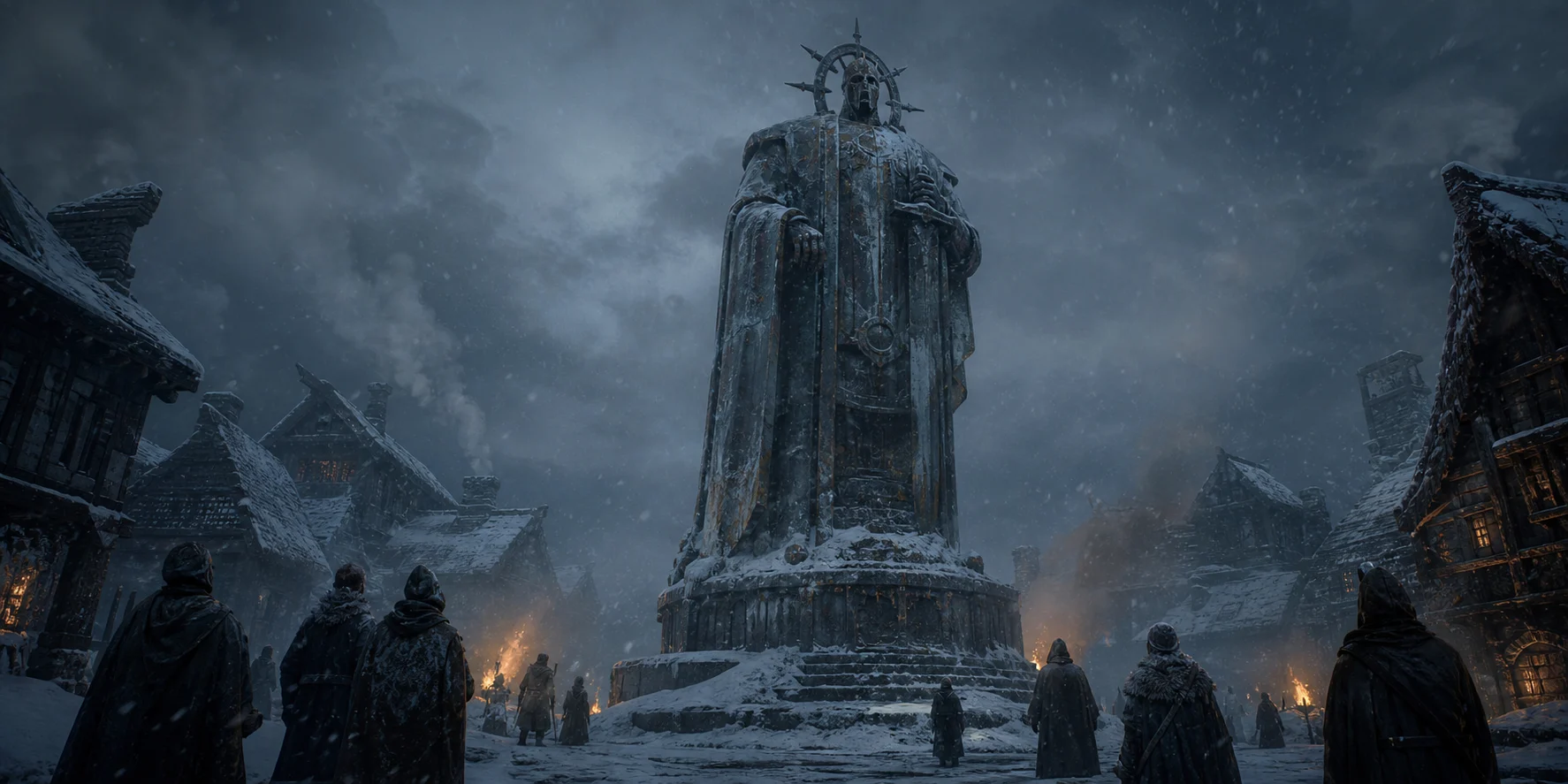
The people of the village had known that statue for as long as the village was around.
The statue towered there in rain, fog, wind and snow—a persistent reminder of the past that had been. Most of the villagers did not remember that past now—dark clouds on the horizon had consumed that past. But the statue, made of some type of metallic steadiness, remained.
The village was old, a relic of ancient times and histories that remained in the world of men. It was at least old enough to have lingered since the days of Mrika, one of the oldest civilizations. Only a few remembered the tales of Mrika, patriarch of old histories—in particular, the village elder, learned in that history, spoke with reverence of the days of yore, when many wise chiefs met in the hall of common speech.
But those times were long gone now, and the people of the village had other matters to attend to. Snow fell heavily over the streets most of the year. Times were hard. The sighting of a rabbit or a cat would have been quite important, really.
They did not find a rabbit or cat, however. They found a man, buried in a particularly odd snowdrift of some note. He looked to be about thirty, though there were strange bruise marks along his neck and shoulders that made the determination of such difficult, and his speech was strange and uncouth. He did not know the meaning of ‘paleva’, for instance, and his curses were strange, but he accepted the meat readily enough.
He followed them to the village, and drank their beer with gratitude—though Gurty, the barmaid, noted that he looked with peculiar fixedness upon the window, and looked a little green. But it was when his eye lighted on the statue beyond the window that the story became more notable.
“God damn it!” he shouted, rising to his feet. “Can I not even escape you here?!”
“What’s the matter, young fella?” the elder asks.
“Him, that damned piece of—” The young man released a few more curse words as he kicked the table, shaking his head.
The villagers looked between each other.
“Maybe it’s not him,” the young man remarked at some length, looking out the window. “But he looks similar enough. Maybe there’s another bastard like him. Oh—to have left you in the twenty-first century.” He scowled as he drained his mug, his right hand on his cheek. “That pot-bellied goblin. Couldn’t he have left well enough alone?”
The village elder—an older man, perhaps in his forties or fifties—spoke at some length. “Young man, we don’t much understand what you’re talking about.”
“Then I’ll tell you—what’s your technological level at?”
The villagers looked at each other without words.
The young man sighed. “I’ll try to explain things, then, in the roughest fashion. My father… he knew a rather wise wizard, and that wizard put me under a sleep for about a thousand years.” He nodded toward the statue. “That man was alive when I was young—and seeing him here, or one very much alike to him, tells me that he got his way.”
“What was so bad about him?”
“He hurt and he killed, and he attacked everyone. The elderly, the infirm, those touched by God—as you’d say it, anyway. The young, the poor. Women and children. The innocent and the guilty. Dark-skinned men, light-skinned men. He did it because it was who he was, and he had never known a reason not to lie. But the worst of what he’d done was to poison the world. He put out a kind of evil spell that blackened the skies.” The young man sighed. “No, that’s too simple. Imagine a fire—large enough to encompass your entire village, and the hunting grounds too. He made fires like that.”
The villagers looked at each other dubiously, but none challenged his story.
Laughing a bit harshly, the young man shook his head. “No, I misspeak. Even the worst of it isn’t that. The worst is that statue out there. It’s the shadow he still casts, the darkness in his heart that lives on. Even when he’s dead and rotten in the ground, the shadow he casts remains. You should tear him down, and it’d be a sorry shame to leave such an ugly thing up, but you can do what you want. Let us not deify men with dark hearts like that.” He departed by the road.
The villagers kept up the statue. After all, their forefathers must have had good reason to put it up in the first place, and who could trust a man from the wilds? Whatever the statue had done, it had been there long enough—a generation or two, by their count, at least, and they felt such a man should be honored.
The statue remained, proud and furrowed brow cast in the firelight that slowly dwindled and died.