The Monday War
Listen now
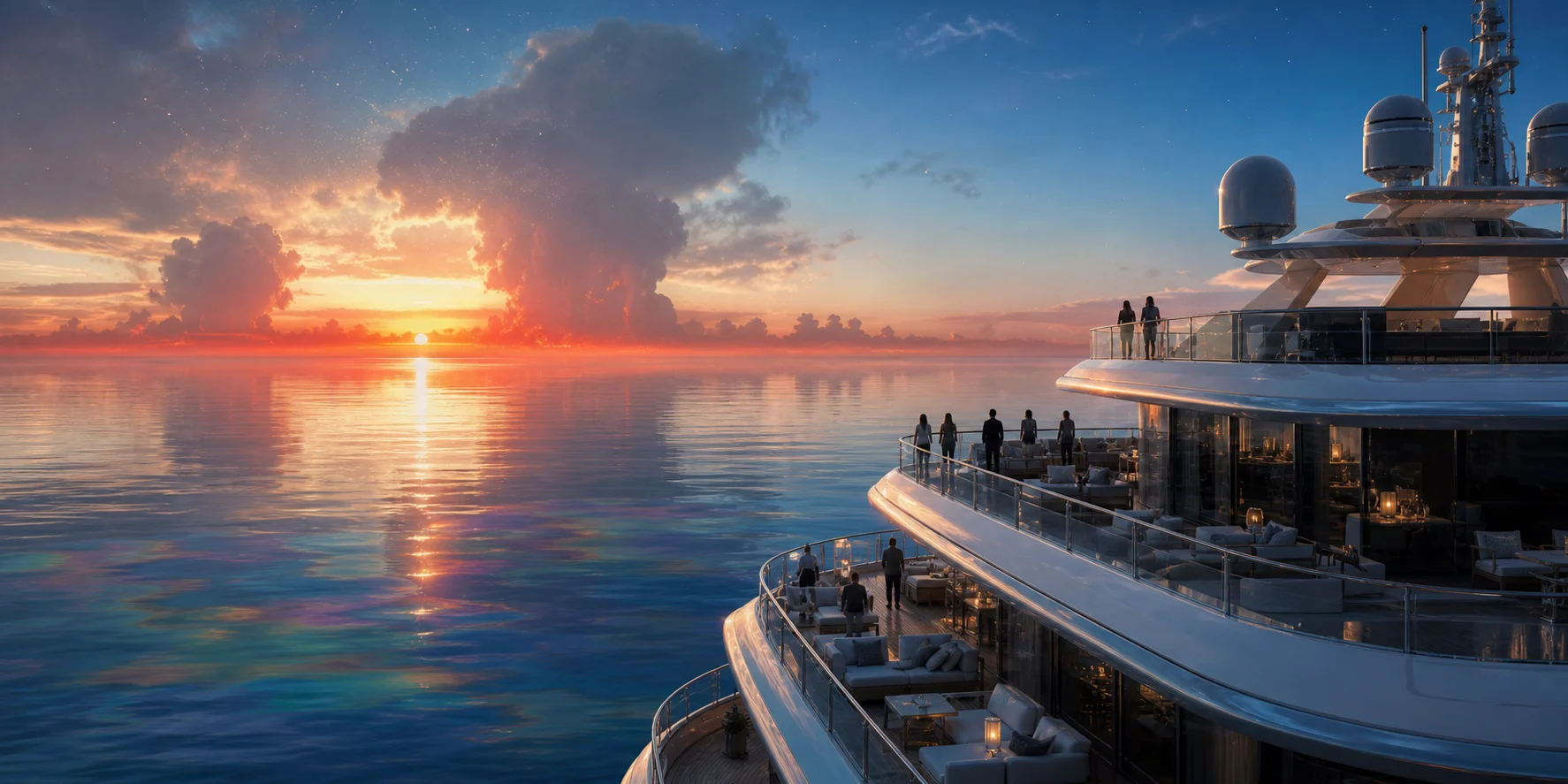
His eyes watered. He was staring at the sun. The sky was clear blue and the water the same. He had asked the staff to anchor where land was out of sight and out of mind, and here they floated, the staff and passengers aboard the superyacht Harmonia, and there was house music swaying over the sound system, bouncing over the waves and through the empty paradise, one song seething into another while he closed his eyes and opened them back up again, waiting for the iridescent weight of visual snow to fall before him, and he thought life would be more exciting if the visual snow was permanent.
Nancy called.
“Yep.”
“January 29.”
“Two weeks. Interesting,” he hemmed. He’d have to stay on the superyacht all that time. He’d already been here for five days and it was Tuesday. He looked at his calendar, and then to Placed, the white house’s favourite betting app. It was novel because the app offered events of any kind on which to bet. The events were not limited to sports or games, which meant of course that you could bet on the outcomes of such things as awards shows or serious conflicts, whether your favourite actor would cry or whether a general would get shot, and of course you could bet on, for instance, the day that World War III would start.
The chances, according to Placed, of WWIII starting next week were low, and higher the week of January 29, when the G20 was scheduled to meet. Apparently, the President was planning to start a couple days after the meeting of world leaders, so it would have surely be a blindside but for the fact that laymen were betting that it would happen that week. But if it happened within the next week, he could expect a much, much larger payout. The odds were very low, with the fewest bets for the next month having been placed for Monday next week. Who starts a war on a Monday?
“Can we do Monday?”
“Monday, January 26, or Monday, February 2?”
“Neither. Earlier. Monday, January 19.”
“Please hold, sir.”
The hold music was a rather innocuous, solo piano version of Tchaikovsky’s The Dance of the Sugar Plum Fairy. He set the phone down on his side table and turned up the volume. He let the horizon blur the sky and sea in his vision. He watched the staff clean the deck, and the shimmering glare of his wife’s tan skin as the thumping house music met Tchaikovsky overhead in a dissonant and difficult crescendo.
“We are in agreement with your suggested amendment to the date of the operation.”
“Ah, good. Thank you, Nancy.”
“Have you made all necessary arrangements for your safety?”
“I sure have,” he replied. “Thank you for asking. Send my best to the team.”
“Thank you sir, I will. Have a lovely–”
He hung up the phone and yelled: “Gerald?”
“Sir?”
“You have a family.”
His own wife craned her head toward him and angled her sunglasses to watch him in the shade. She applied some more oil.
“I do. A wife and a dog.”
“Sort of a family. A wife and a dog. So, here’s a thought experiment for you,” he said, “let’s say that you found out that the apocalypse was going to start while you’re on my boat.”
“Uh huh.”
“Would you stay on my boat and go to my super bunker with me and live to see the other side of the apocalypse, or would you ask to be dropped off so that there was the chance you could see your wife and dog? What’s your dog’s name again?”
“Barry.”
“Gerry and Barry. Cute.”
“Gerry, and Barry and Gladys, my wife.”
“Right, right,” he said. Having been the second steward for the Harmonia for her last six charters, he assumed that Gerald was used to his thought experiments. He waited for Gerald’s answer. “Remember that it’s Armageddon, so when you get to land, people are getting flayed, some are ascending to heaven, there are sinkholes everywhere, demons are pillaging, etc., and you have the option to go somewhere completely safe from harm. And you’re still making money and everything, but you have to leave on Friday, and you can’t see Gladys or Barry, probably ever again.”
His wife returned to her posture, baking slowly in the sun.
“Can I call Gladys?”
“Sure.”
“Can I tell her where I’m going?”
“No.”
“Well, I guess if it’s Armaggedon and the whole world is falling apart and I can call her, then I’d go to the superbunker.”
“So you’d save yourself.”
“Maybe, I guess?”
“It’s your life.”
“Sure. Yeah, sure, sir.”
“Good choice!” he said. “A dry martini. Three olives.”
“Absolutely sir,” and without hesitation, Gerald went to the bar and got him a dry martini with three olives, noting that they were running low. They’d need to get some more at their next docking. The day and the day next proceeded this way, where he probed the interior and exterior staff, searching for contributions to his thought experiment. He went to the kitchen for an ice cream, and happened to find the chef, a deckhand, and the Chief Stewardess. He cornered the third stewardess in his bedroom. He shared a glass of wine with the Captain. Slowly, he combed through the boat staff until he received answers from every one of them, including the Engineer, and he was happy to find that almost everyone would choose the bunker if there was an apocalypse. At dinner on Wednesday night, his wife took a sip of wine and asked him:
“Are there any hold outs?”
“Oh sure. We’ll be dropping off the bosun at port tomorrow.”
“Friday. How much longer do we have on the yacht?”
“Sunday.”
“Ah, all right. You had those sun lamps installed, though?”
“Of course. They light the orchard.”
“Good, that’s nice,” and she leaned over for a kiss. She lit a cigarette. “So the bosun has a life, huh?”
“It appears that way.”
“Good for him,” she replied. They finished dinner and went their separate ways at bed.
As with the night before, he was unable to sleep, and he walked the deck at midnight or so and surveyed the stars, and he admired them, unable to name them, and he looked for pockets of abyss in the Milky Way, and he saw countless stars, millions of stars, millions upon millions, billions, even, billions of stars, each surrounded by airless void.
He’d arranged to have a Black Hawk land on the superyacht to procure him, his wife, and the staff after the bosun was dropped off at port, and Thursday was heaven, clean and easy, and it reminded him of a hotel bed well-made and ironed, and he drank all day and took the world’s best ecstasy at night, and took viagra to repeatedly fuck the third stewardess, and the meals were delicious and exactly to his liking, and he was sad for his wife since her boat boyfriend was choosing land, but she’d find somebody else and it wouldn’t be that bad, and she’d undoubtedly find other things to do, other things to say, other things to feel, other faces to read and one day become, and Friday came, and the bosun left the boat with his rucksack, and everybody shook his hand and some were crying, thinking he’d been wrongfully fired even though he was truly a skilled and popular bosun, and as usual, where docking was concerned, some crew members left the boat and returned with goods, including additional olives.
While they were out, the Captain gave him the news: “The weather’s no good, sir. It appears that a storm will be coming this evening. No good for getting back out on the water.”
“That’s fine,” he replied. “But we have to be back out tomorrow.”
“Weather permitting,” said the Captain.
And to keep from appearing suspicious, he replied: “Weather permitting, of course.”
But Saturday came and the weather did not permit them to go back out on the water. That’s all right, he told himself. We have until tomorrow. Saturday was a buffer.
But the Sunday weather did not permit them to leave. The storm was raging.
“Can we go to a hotel?” said his wife. “Isn’t it more suspicious to stay on the boat during the storm?”
“No, we have to stay here,” he said. “We have to stay here.”
“Sir,” said Gerald that evening, “Are you sure you want to continue this charter? The staff need a break.”
“No one leaves,” he replied. “I’ll pay you extra.”
“Of course, sir,” whispered Gerald.
The people in town knew to whom this superyacht belonged, and as the monsoon raged, they walked by it each with his threatening gaze, eyes glaring from beneath their hoods, faces in shadow, flip flops slapping against bare feet loudly through the downpour. Passersby dreamt of how many people the Harmonia could hold. She was guaranteed to be a target if shit hit the fan. She was known the world over as her proud owner’s prized possession and therefore she was a famous boat.
Mid-afternoon he made a call to Nancy.
“Nancy,” he said nonchalantly. “What would they say to January 20?”
“Tuesday, January 20?”
“Yes.”
“Please hold.”
There was the solo piano version of The Dance of the Sugar Plum Fairy, and it was quite uplifting until it reached its crescendo. He forgot. He wasn’t listening to it the last time. The crescendo was somber, like a fall wind sweeping through a tree of many withering brown leaves, and he was pulled into a memory of Fantasia, where he was swept away himself into a dank, chaotic fiction, an autumnal freezing, a frost setting the warm sea cool, and Nancy returned.
“The operation remains as at Monday, January 19.”
“I may not be safe.”
“My apologies, sir. The operation is already in motion, scheduled to begin at 5:00AM Eastern Standard Time on January 19. We need more than 24 hours notice to change the date of an operation of this scale.”
“Do you know who I am?” He whisper-screamed. “Do you know what I could do to you?”
“Sir, I do know who you are. My apologies. I hear you are upset. I can only do my best. I am an artificial intelligence. I don’t make any decisions.”
“Of course–-of course you don’t,” and for the following hour he pursued the manager, the executive, the chief, up and up, and by the end he got from them the same answer as he’d received from Nancy, and no favours could be called in to change the date, and sat slumped on his bed for a moment, and he thought of seeking solace from his wife, or from that stewardess whose name he always had trouble remembering, but then he smiled as he reflected on the operation’s starting hour, and he said aloud: “5:00AM.”
They happened to be in a different time zone, fortunately one hour behind. He went to the Captain.
“Good news, sir,” the Captain said as he entered the bridge, “the weather is looking clear from tonight onward.”
“What a relief! When can we leave?”
“The morning, of course.”
“What would you say to leaving at 3:30am? Or is that too early for you?”
“That’s quite early sir. Is it for fishing?”
“No, no. Yes, I see it’s early for everyone. What about 4:00am?”
“4:00am could work. Do you have a destination in mind?”
“Not yet. Let me think about it. But let’s plan to leave at 4:00am. I’d like to see the sun rise.”
“You’ll see the stars and the sun if we leave then, sir.”
“Perfect.”
He made a call to his Black Hawk contact, who had been on standby for the last couple of days waiting for an adjustment to their schedule. Everyone woke just before 4:00am to leave for the open sea. They anchored before the sun rose. The Black Hawk landed at 4:45am, much to the confusion of the staff. The Captain refused to board and stayed with the boat, and the last deckhand and the engineer stayed with him, and only the interior staff remained on the Black Hawk, as well as the purser, which suited him just fine, because it was their decision to stay on the boat, and he needed the Interior to survive the end of the world, and about fifteen minutes after they departed the Harmonia, the news came that the US had waged nuclear war on all of its allies and enemies in North and South America, and he remembered the conversation he’d had with the president some time ago.
“You know, it’s the United States of America,” said the President.
“Yes,” he replied.
“So shouldn’t that include North America and Central America and South America? Because it’s the United States of America.”
“Sure, why not,” he said, because it was the President, and the only word the President understands is something akin to “Yes”, so you always say “Yes” to the President, whether or not you agree.
The staff surveyed the landscape behind them, where the sky met the ground with a terrifying, clouded scream. A red and orange smudge that stole the air from their lungs. He stared straight into the sun as it dawned. His eyes watered, and the visual snow fell, and what he saw in front of him was a clear, blue sky, and an iridescent snow fell upon him like diamond dust, a lavish icing, the oily surface of a water pool outside a gas station after the rain.