Stand by for Redeployment
Listen now
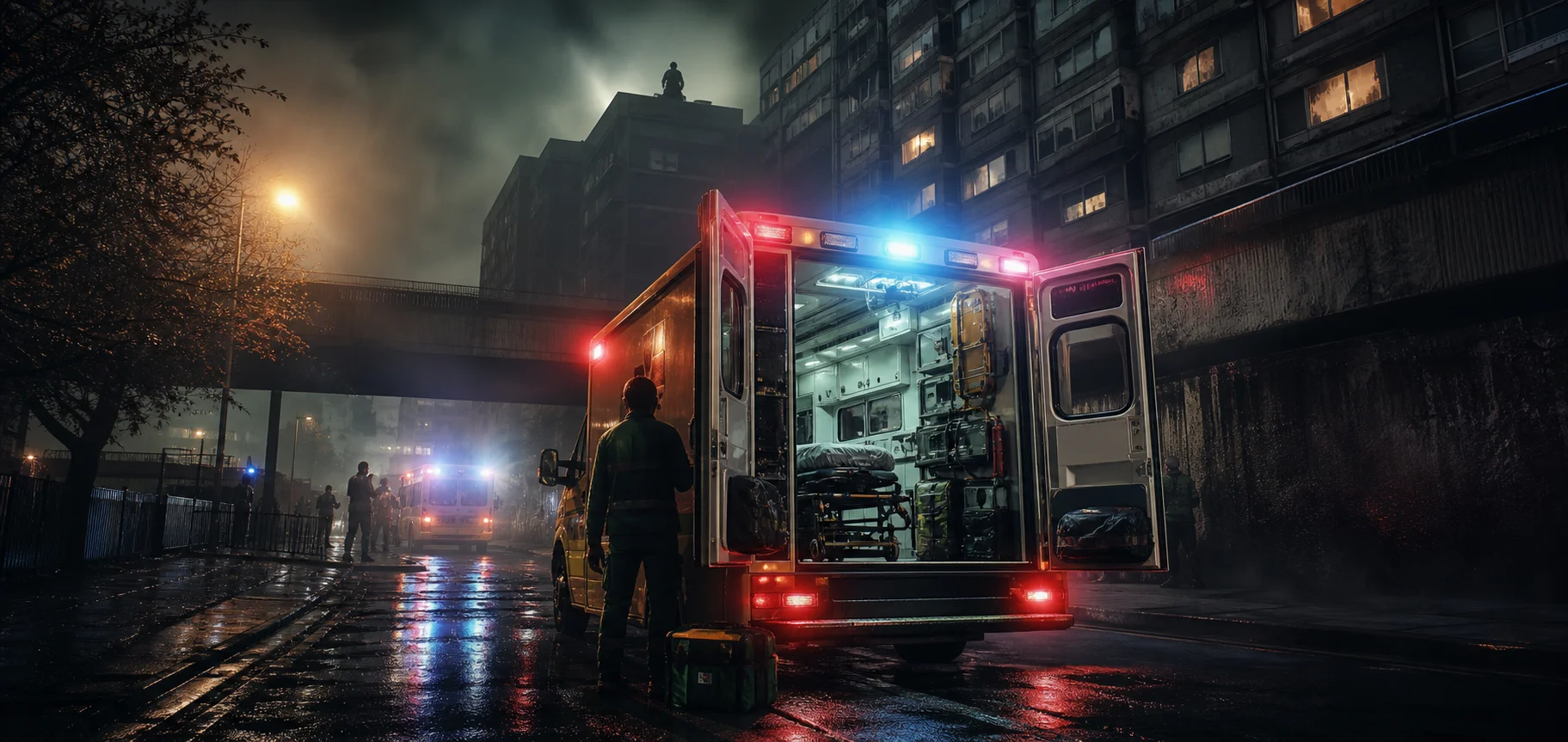
We were already running hot, sirens tearing through the morning traffic.
“Barbican Estate. Male, forties, struggling to breathe,” I said.
Sadie tugged on her gloves. “Not another one.”
“What’s the ETA?”
“Ten if the lights behave. Fifteen if they don’t,” Eric called from the cab.
“Let’s make it ten. Quick as you can, but keep us safe.”
“Safe?” Sadie leaned forward. “Dan, you’ve seen what’s happening out there, right?”
Eric huffed a laugh. “I don’t believe it. We’d know about it if something was happening.”
Sadie shook her head at Eric and planted her fingers on the cabinet as the ambulance accelerated.
“Laugh if you want. I’ve seen it. I reckon it’s a cover-up.”
“Could be, but—”
“Eyes on the road.” I glanced at Sadie. She was right—I saw the record in the office this morning. “Get the oxygen ready. We’re gonna need a full tank.”
She looked up, reached for the cylinder, and snapped the regulator into place harder than she needed to, before checking the gauge. Control downplayed the casualties in the briefing. I’d signed the overnight report myself. The numbers didn’t match. And we were the ones counting bodies.
“I lost three people yesterday. All respiratory. You two were working together last night, right? Anything unusual?”
“Yeah. There was a girl. Seventeen. No history. We picked her up on the Old Kent Road.”
Sadie kept her eyes on the gauge as she spoke.
“It didn’t matter how much oxygen we gave her. Her throat… it… she convulsed right in front of me. And that was it. I watched her die.”
Eric shifted in his seat. “Tell him about the blood.”
“She was bruised. Swollen everywhere. Had these purple clumps under the skin, and then it just… seeped. I’ve never seen anything like it.”
I studied her face. “Seeping out?” I said. “How long until her airway closed?”
The ambulance jolted sideways. The tyres screamed against the tarmac as the defibrillator slammed loose behind me. I smashed hip-first into the cabinet while Sadie grabbed the rail and Eric hauled the wheel straight. Another ambulance tore past on the wrong side, siren wailing, close enough to rock us. One more second and we’d be names on a report instead of writing them.
“Bloody hell—” Eric said.
Then we saw it.
The junction was a knot of metal and noise. A black cab skewed sideways, its bonnet concave, steam blasting out in white jets, and a silver hatchback lay buried in its flank, its back wheels hanging uselessly. Smoke and coolant bit at the air. Inside the cab, the driver sagged over the wheel, blood threading down the meter. In the hatchback, a woman yanked at her belt, jaw stretched wide, her cry barely audible beneath the horns and the shouts swelling on the pavement.
I reached for the radio. “I’ll call it in—”
“There’s no time.” Sadie already had her bag off the hook.
No sirens. No blue lights. No uniforms. Just glass and debris strung across the tarmac. Sadie slung the strap into place and shoved the rear door open.
“Sadie, wait—”
“I’m not leaving them.”
Sadie jumped down from the ambulance and ran.
I leaned out after her. “All right. Go. We’re five minutes from the Barbican. Stay till backup arrives, then meet us there.”
She didn’t turn. Just raised a hand and kept moving.
Eric looked at me. “You sure?”
I watched her kneel beside the nearest driver, already moving.
“Drive.”
Shortly after, we turned into the Barbican. Concrete rose in tiers and ledges before the towers showed themselves—three brutalist slabs rearing forty storeys above the estate, raw faces weathered with age. The road dipped under the podium, the light draining away, a shadow rippling over the asphalt as we passed beneath.
“Which block?” I called out.
“Tower One.”
“Robert Boyle, right?”
“Yeah. Breathing difficulty. Forty-eight.”
I grabbed the response bag and stepped out. Eric followed.
“Hold this.”
I gave him the bag and pressed the intercom. Flat 34. It hummed as the call went through. We waited. Nothing. I hit the trades buzzer and shoved the door. It gave.
“Third floor. Let’s go.”
The lift was out of service, so we took the stairs. The stairwell lights flickered, their hue stained nicotine yellow. At the landing, Boyle’s front door stood ajar. Scratch marks scored the lino to the concrete, and a black substance crawled up the walls.
Eric slowed. “You see that?”
“Yeah.”
We waited.
“Mr Boyle?” I called. “Robert?”
Nothing. I met Eric’s eyes. He nodded. We went in. The smell hit me first. It raked my throat, sharp enough to sting my eyes.
Eric slowed behind me. “You getting that?”
“Yeah. Something’s wrong.”
“Robert? Mr Boyle?” I stepped further inside, eyes adjusting.
The living room sat empty. Dark. Damp. Curtains pulled tight. Plaster was torn from the walls, gouge marks deep and ragged, blood ground into the dust. The TV was on, muted, casting blue light across the clutter, revealing it piece by piece.
“Clear,” Eric said.
I nodded and edged toward the kitchen partition. The space tightened as I drew closer.
“He’s in here,” I said.
I slid it open with my elbow. Mr Boyle sat on a wooden chair in the middle of the kitchen, face buried in his chest, retching. He was down to his underwear, coated in the same black substance—crusted in places, wet in others. I couldn’t tell if it was blood.
The stuff crawled across his skin each time he coughed. It pooled beneath his feet, spreading around the pine legs and bleeding into the grout. Dirt and plaster clung to his bloodied fingertips. His nails were barely visible. One leg shoved the seat back, scraping lines through the filth on the tiles. The other was folded under him, skin rubbed raw against the wood.
“He’s in respiratory distress. Unknown contaminant. Don’t touch it,” Eric called back.
“Mr Boyle? We’re from the ambulance service. Can you hear me?”
Boyle tilted his head just enough for his eyes to catch the light. Crust clung to his lids, split where they’d cracked open. His wrist jerked. He lunged, snatched a knife from the table, and drove it at me.
“Don’t—don’t touch me,” he snorted.
The blade flashed past my flank. I stumbled back and hit the floor. Eric slammed into him shoulder-first, sending the knife skidding across the tiles.
“For fuck’s sake. Restrain him.”
Eric hooked an arm across Boyle’s torso and drove him into the counter, his boots skidding on the clammy floor. Boyle coughed, fighting and hitching.
“Hold him there.”
Before I could reach my radio, Boyle doubled over. He shot out a painful cry as he dropped, dragging Eric down with him. I fell beside him, fingers already at his throat for a pulse.
“Mr Boyle, can you hear me?” I turned my head. “Eric—you okay?”
“Yeah,” he said, sweat running down his temples. “All good.”
Boyle didn’t respond. His eyes fixed and filmed over. His body jerked every few seconds.
“We’re losing him.”
I grabbed his arm and hauled him flat, kicking the chair clear. Then I drove my hands into the centre of his chest.
“No pulse. I’m calling it in.”
Eric took over compressions, counting quietly as the residue smeared beneath Boyle’s back.
“Control, LAS on scene, the Barbican. Male, forties. Cardiac arrest. CPR in progress.”
“One, two, three—”
“Requesting police and additional units. Urgent.”
Eric didn’t stop. His arms locked, his weight rocking forward with each compression, Boyle’s body jolting beneath him.
“Keep it going.”
Eric kept compressing as the slick spread under his gloves, staining the latex. A shudder ran through Boyle’s abdomen. Eric’s arms slowed as he looked up.
“Dan… he’s gone. There’s—”
A rending snap erupted from the living room. I turned. We weren’t alone. I pushed up and moved toward it. Eric came after me, dragging his hands down his trousers.
“Hello? Ambulance service. Who’s there?”
Silence. I edged into the living room. The gouged wall had split open from the inside, pale fibres hanging like cotton where the plaster had burst. A pungent chemical draught drifted out of the hole.
“Easy.”
Eric crouched, peering into the gap.
“Wait.”
A faint sound came from inside, almost a voice, but not quite.
“Someone’s in there.”
He inched towards the opening.
I caught his arm. “No. We hold.”
“Dan—”
“We wait for backup.”
Eric didn’t look at me. His eyes stayed on the hole in the wall.
“You heard that. That’s a person.”
He turned to face me.
“Last year, on that building site. We thought we got everyone out, and we stood there while he suffocated behind that wall. I’m not doing that again.”
I remembered. The memory tasted like the drywall dust. We’d thought it was the pipes. The poor man wasn’t breathing when they pulled him out. I still hear it—thump, thump, thump.
“Thirty seconds. I’ll drag you out myself if you’re not back.”
He was already inside.
“It opens up back here,” Eric called.
He stopped short, then choked.
“Jesus… It’s everywhere.”
The torchlight dragged along the inner wall.
“I think it’s an old service duct.”
I stayed where I was, beside the hole. Eric’s beam slid farther in, thinned, then vanished.
“Be careful. Don’t touch anything you don’t—”
A faint rustle. A boot against a brick. Movement stirred behind me, and I spun around. A teenage boy stood there, half-lit by the kitchen light, already watching me.
“Nate? That you?” I stepped closer, softening my tone. “You alright, mate?”
He hovered in the hallway, arms drawn in tight, eyes flicking between me and the hole.
“You live up here with your gran, don’t you? Twenty-first floor.”
He nodded quickly. “Yeah. I saw the ambulance from my window. I followed you in.”
“What are you doing—”
The floorboards groaned. Eric screamed. The sound ripped out of him mid-word. Nate flinched, his head snapping toward the wall.
“Dan—something’s got—”
Eric’s torch dropped and clattered somewhere inside the wall. His voice broke, then cut off. The hole was empty. I looked back at Nate. He hadn’t moved.
“Did you see that? What happened to him?”
“They took him,” Nate whispered, already backing away—then he ran.
“Nate—no. Stay where you are.”
I grabbed him at the front door. His foot hit the slick and skated. I caught his hoodie before he went down.
“Nate, look at me. What happened? Where’s Eric?”
He froze. His eyes filled, but he didn’t cry.
“Where does it go?”
He swallowed. “To the basement. I think.”
“How do you know?”
“My gran. She’s down there. Got sick a few days ago—she couldn’t breathe properly.”
“And?”
“When I woke up, she was gone. And there was a hole in her bedroom wall like that.”
“Why didn’t you call the police?”
“I did. No one came.”
“Alright. Stay here. Don’t move.”
I turned back to the hole.
“Wait—” Nate’s voice cracked behind me.
“If I’m not back in two minutes,” I said, dropping into a crouch, “run outside and wait for the police. They’re on their way.”
The hole exhaled a draft against my face.
“Eric?”
I ducked into the opening, and the light vanished. Brick pressed tight, stale and damp, hanging in my nostrils. Instead of the floor, my boots found a slant of crumbling board covered in grit. Then it gave. I hit hard on all fours. Dust billowed upwards, and the haze smothered everything. For a second, I didn’t know which way was forward.
“Are you alright?” Nate called faintly from above.
“Nate,” I called back. “Go get help. Now.”
I stayed low, one palm flat to the concrete, and reached outward—a shaft. I turned, tested the edge with my boot, then swung my legs over and lowered myself in. My stomach tightened as my foot found a rusted bracket below. The air felt thick, heavy with a festering weight.
“Dan—”
Eric. On the floor below.
“I’m here,” I said.
Silence again. Then a soft scratch, like someone dragging themselves across the floor. I edged forward, feeling ahead little by little, muscles clenched.
“Eric,” I called, quieter now. “Keep talking.”
“Down here…”
The sound barely reached me. I crouched and felt again until I slipped—another hole. I swung through and dropped, landing harder this time. The impact shuddered up my spine. The smell pushed up again—stronger, thicker, as if the dark itself were infected. I was back on my feet within seconds.
A flicker crossed my peripheral. I thought I saw movement along the wall.
“Eric.”
A weak call answered from up ahead. I moved toward it and turned on my torch. It flickered, as if it didn’t want to show me. Shadows jumped and collapsed against the walls, stretching and recoiling. In the broken light, the floor was torn open, concrete split as if it had given way. Eric lay just beyond it, half on his side among collapsed piping and broken lengths of conduit. He was tall, he’d always been tall, but the way he was folded over made him look small.
Twisted debris had driven through his hip and torn out behind his ribs, pinning him to the floor. His hi-vis jacket was soaked almost black with blood, the residue layered over it in viscous sheets, curdling like oil in water. His skin had gone waxy and pale beneath the grime, the colour leeched from his face, and his lips were already tinged blue. Each exhale came with a wet, rattling cough, red bubbling at his mouth before he forced it back down.
I stood there. The part of me that knew what to do recoiled until all that remained was him—my friend pinned to the floor.
“Eric,” I said.
He jolted. A sound came out of him—but it wasn’t a word. He tried again.
“Dan.”
It came in pieces between gasps. I was already by his side. There was no version of this where he got up, and no angle I could pull him free.
“I’m here,” I said. “I’ve got you.”
Eric shook his head, just enough to tell me not to lie.
“I was dragged.” Blood bubbled at the corner of his mouth. He swallowed and tried again. “Th—through… the wall.”
“I know,” I said. “Don’t talk.”
He tried to smile. It didn’t work. It pulled wrong, his face collapsing into something that tightened my stomach.
“I knew you’d…come,” he managed. Another cough shook him.
I pressed my hand into his shoulder, careful not to touch the metal rod.
“I’m here.”
He leaned as close as he could, his breath warming my face. His eyes had sunk deep, glassy and unfocused. I searched for the man I’d known half my life—for the friend who’d stood beside me in every corridor, night shift, and mess we’d walked into together—every person we’d brought back from the edge.
“S-something dragged me… down here, Dan—go.”
“I’m here now.”
A scream split the stillness—human and helpless. I closed my eyes. I knew that voice.
“There’s a kid. He’s on his own. Whatever it was took his grandma.”
Eric watched me, or tried to. I could see him slipping, piece by piece, the way a shoreline goes when the tide pulls out.
“I can’t leave you. Not after everything. You’re my best mate.”
Eric went still. His eyes glistened under the torchlight, tears spilling down his cheeks. I didn’t notice my vision had blurred until his face slipped out of focus.
“Dan.”
I shook my head. I knew what he was about to say.
His eyes sharpened for one last second—
“G—go,” he whispered.
I stayed one second longer than I should have. Long enough to break every promise I’d ever made in uniform. Then I stood. I didn’t look back. If I had, I wouldn’t have moved at all. I pushed on faster. Then I was running. The darkness closed in, walls appearing only when I neared. The screams came again—louder this time, pulling me through the blind like a rope.
Something kept pace behind me. As the door took shape ahead, the scream climbed higher. I grabbed the handle and pulled. It didn’t move. I tried again, harder this time. The metal held fast. I felt along it until I found the bolt. It was drawn across and set firm, locked from the inside.
“No—”
I slammed into the door. The impact rang through the basement and came back to me hollow. Behind it, Nate’s shout broke into a whimper.
“Nate. Hold on!” I called. “I’m here. I’m here.”
Another sound shattered, pausing and starting again, deep enough to vibrate in my chest. I shoved the bolt, kicked at the frame, clawing for any give, but it didn’t so much as tremble. Beyond it, the atmosphere tightened. Nate’s whimper faded. A dragging sound crossed the floor, retreating until it thinned into the distance.
“Nate…?”
Nothing. I hit the metal with my palm.
“Oi. Nate. Come on—answer me, mate.”
Silence.
The name tore out of me raw. I didn’t care what else might hear.
“Nate, please—”
My forehead rested against the metal. Then I was on the floor and hadn’t felt the fall. I couldn’t steady myself. The air was pure acid in my throat, each inhale shredding skin. My legs trembled without rhythm, my heart kicking wild and uneven. I knew exactly what was happening to me. But knowing didn’t help.
For a while, I didn’t move. I couldn’t have said how long. Time had loosened its grip, stretched thin. I stared into the unlit corridor, waiting for movement.
“Dan. Dan—it’s Sadie. Are you there?”
Static hissed across the radio. I swallowed. My throat burned.
“I’m here.”
“Dan. Are you hurt?”
I tried to speak. The words barely came out. I hauled air in, and my chest fought it back.
“I’m… alright. But I’m stuck.”
Sirens wailed faintly on her end, warped and distant.
“Where are you?”
“I’m in the basement. Barbican. Tower One. I—”
“Listen to me,” she said, firm. “Stay where you are. I’m coming to you.”
“I couldn’t save them, Sadie. None of them—”
She didn’t hear me.
“Dan… I’ve got mass casualties. That crash—it wasn’t just a crash, it was different. They started choking and clawing their throats. People ran to help. Then it spread. One after another.”
I pressed my forehead harder into the door. She took a second before speaking again.
“I had the mask on him. He nearly snapped my wrist. Eyes wide—like he’d seen someone standing behind me. Then he choked. Just like the patient I told you about.”
She caught her breath.
“People are lying in the road. No police. Just noise. It’s chaos.”
Her words blurred in the static. I tried to stay with her voice rather than let the walls close in on me.
“Sadie… Eric’s gone.”
Silence.
“What?”
“He fell. From Boyle’s flat, into a service shaft. Impaled on a metal rod. I got to him, but I couldn’t do anything. I couldn’t get him out.”
The radio hissed softly between us.
“I tried. He was talking to me and I just—”
“Dan—”
“—There was a kid here, too.”
I clenched the radio until it screeched.
“Nate. He was waiting outside. I told him I’d be a minute.” He’s dead.”
She didn’t answer straight away. I could hear her panting, fast from running.
“I’m five minutes out. The roads are blocked.” Her boots thudded over glass. “You hear me? ”
“Sadie. Don’t come. It’s not safe.”
Her boots kept striking the pavement.
“Five minutes.”
My eyes stung. I pressed my sleeve across them, angry at myself for it.
“Sadie. I—”
“Dan. You don’t get to clock out before I get there. Not after everything. Stay put.”
I made a sound I didn’t recognise. Half laugh, half sob.
“You always were bossy.”
“Yeah,” she said, softer. “Someone has to be.”
A bang sounded in the distance on her end. People screaming. Feet pounding.
“Sadie?”
Static swelled. The line dropped. She didn’t come back.
I jabbed my radio.
“Control, this is Dan. Status on police?”
Only static.
“Control, respond. I’ve lost Eric. Control—come in.”
Nothing.
“Fuck.”
The line was dead. Only a thin hiss remained. Then a sound. Far off. A scrape. A step, weaving in the murk toward me. My body refused to stand, but I stood anyway. I turned the opposite way from where I’d left Eric. I didn’t look back. Just turned into another unlit stretch. The gloom thickened as I went, engulfing what little shape my eyes had learned to hold.
I kept close to the wall and set a pace. Each step carefully placed so I wouldn’t slip or make a sound. The blackness crowded in, close enough to touch. It moved with me, learning my rhythm. Behind me, the sound gained ground. I moved faster, keeping to the wall, feeling dead space. Then it got louder. Nearer now. Scrape. Step. Scrape. Step. The dark between us was tightening.
My fingers struck metal, cold and flat under my palm. I froze, every nerve listening as the scrape and step behind me came closer. I kept my eyes forward and mapped the surface. The confines around me tightened as if something was leaning in, watching me.
I found the bar and slipped, sweat skidding my grip across the metal. At my back, scrape, step. Closer now. I tried again, forced the bar, and felt the rusted mechanism give with a blunt click. The light hit me like a blow, merciless after so long without it, pouring down the redbrick throat of the stairwell, I stumbled in half-blind. A way out. The frame slammed shut behind me.
My senses thinned to a thread, and I felt how little of me was left. Above me, the building was alive. It spoke in distant screams folding over each other.
A blow struck the walls hard enough to travel through the railings. Clotted smears streaked the steps—handprints and scratches, like bodies dragged by the heels.
I reached the ground-floor landing and pushed the bar. It didn’t move, so I threw myself into it. The door shuddered but held. Dead weight pressed back from the other side. Wired glass revealed a grid of maroon smears. Blood fused with the residue, a veined film that dulled the light and hid what lay beneath.
I didn’t try again. I clambered up instead. The smell crept in fast, like chlorine failing to hide the stench of death. The landing light flickered. When it steadied, I saw them—piled against the far wall like they’d tried to climb each other to escape.
Bodies.
Arms webbed together, faces pressed into backs. Skin filmed with the same residue, streaked with blood like paint dragged by careless strokes. One of them twitched. Not alive. Just settling. A limb slid a fraction, skin peeling softly from the one beneath. The pile held. My eyes caught a face. I didn’t look for long.
The third floor found me on the balls of my feet, each step placed slowly. The landing rose ahead, and the corridor opened into a strip of jaundiced light. A fluorescent bulb swung on its wire, bruising the walls with its faint glow. Streaks ribbed the plaster from floor to waist height, and a black drip ticked from the ceiling. I edged closer to the landing.
“Wait—wait. Please. Don’t—”
It came from somewhere down the corridor, a shape sloughing across the lino.
“Please—”
Her plea snapped into a choke. A thin sound broke from her as she struggled. She was dragged backwards into view and saw me, heels carving twin smears. Something pale locked around her ankle, a baby monitor clenched in her blood-soaked fist. She reached for me. The white-knuckle grip tightened, her fingers deteriorating as she tried to pull herself forward.
She never looked back. And I don’t remember deciding. I was already at the entryway, easing the door toward the frame, inch by inch, praying the hinge wouldn’t speak. The gap narrowed as her arm slid toward me. I shut it. A part of me shut with it. The latch clicked into place, cutting short her cries. My stomach folded in on itself as I stood there with my palm on the bar, listening while the silence on the other side listened back. Sadie would’ve run toward it.
Instinct pulled me to the radio.
“Sadie. Come in.”
Only static answered.
A veiled scream drifted through the building, distant, constricted. For a second, it almost sounded like her. I keyed it again.
“Sadie.”
No answer. I kept climbing. The steps wouldn’t stay still under my feet. I dragged along the rail to keep myself upright. By the last flight, my legs shook hard enough to rattle it. Above the final step, a ladder climbed the wall, its bolted rungs chipped with old paint. A square maintenance hatch waited in the ceiling.
Light leaked through the seams, a chalk-pale line cutting across my face. I reached for the first rung and missed. I tried again and caught it. The metal was warm, holding heat that wasn’t mine. The hatch hung open, easing on its hinge, as if someone had just gone through. The ladder groaned as I pulled upwards, my eyes fixed on the line of light above.
The sky hit me first.
The horizon shuddered with hundreds of fires, red blooms catching the undersides of the smoke in the distance. Helicopters cut across the city in hard lines, fast and low. They weren’t searching, they were fleeing—vanishing into the smog as the ash closed over them.
Not far off, a flash lifted between the roofs, white at the core, then orange. A second later, the blast hit the street. I froze as flames shot up in smoky plumes, leaving nothing untouched. The lip of the roof drew closer, wind slipping up the face of the main tower and under my clothes. At the edge, the drop rose to meet me.
Below, bodies lay where paths crossed, where grass should’ve been green. Sprawled out, flung far and wide. Between them, cars sat skewed at angles, hazard lights blinking, waiting for nothing.
The smoke got heavier, dragging through the buildings, thick with that same chemical rot. Scattered sirens sounded in the distance, rising and dropping, never settling, directionless. Beyond the estate, the roads lay open, and junctions stood empty where traffic had locked them solid hours before.
My radio crackled against my shoulder.
“Dan. Come in. Dan, this is Control.”
“It’s Dan. I’m here at the Barbican. Pull me out. Now. Something’s here in the estate, it’s—”
My jaw tightened.
“We walked in blind. Eric’s gone—Boyle’s dead. Whatever’s here is killing people. It’s fast…it’s everywhere.”
The words hung in the air.
“We know, Dan.”
“You knew? You knew it was in here, and you still sent us in?”
“Dan. Lower your voice.”
“What’s happening? I saw the figures. How many are dead? Don’t lie to me.”
The silence swelled until all I could hear was the hum inside my ears.
“Dan. Are you injured?”
“What do you think? People choking, dropping in the street, getting dragged off by God knows what, and you still sent us in.”
Something was on the roof. I looked up.
A figure. For a split second, it passed for part of the vent housing, same colour, same texture. Then it stirred, just enough for the light to slide across it.
It knew I’d seen it.
My chest seized, like a trap snapping shut around my ribs. Heat drained from me, every nerve pulling tight.
Ten paces.
Close enough that it didn’t need to move.
It wasn’t hiding. It was waiting for me.
The radio spat back to life.
It tilted its head towards the sound.
“Dan. Stand by for redeployment.”
THE END