Point Nemo
Listen now
When it entered the upper atmosphere the computer tracked its trajectory and started the ship’s engines to intercept it at its terminus. When the time came he left the computer terminal and stood on deck smoking a cigarette and watching the stars. The ocean was calm and the night sky was clear; after two minutes he saw a pinprick of light flare like a spark as it raced down the meridian and disappeared silently into the blackness of the ocean, like a sparkler into a barrel of water. The boat churned onwards for some time before the main engines stopped, leaving just the whine of positioning thrusters and the slap of water on the hull.
They had found no salvage these four weeks past and he knew it was simply a matter of time until they were muscled into less profitable waters by some bigger bad. The Indian and Chinese salvage crews had their run of the state-funded launches, usually benefiting from re-entry trajectories and projected impact coordinates sent through some lucrative back-channel; but that still left the private ventures and second-wave space powers, smaller states just dipping their toes into orbital freight and satellite launches. These B-players constituted most of his customers, looking to the black and grey markets for salvaged pressure vessels and thrust chambers, hoping to skip a rung or two on the ladder towards economical space-faring. The Polaris and its skeleton crew would loiter illegally at the centre of Point Nemo for as long as supplies and competition allowed, the computer monitoring chatter and using its small satellite network to find viable salvage targets and intercept them before other crews.
When he checked the computer there was no entry in the public registry to correspond with any planned de-orbit, but that was becoming more common, as the race to leave earth escalated and rival factions delved deeper into the stars to lay claim to the expanse and build their fleets of orbitals. It was good news; it wasn’t state-sanctioned, so the bigger players would show little interest. There were no other vessels within a day’s sailing, so Polaris would have all the time it needed to find and retrieve something of value. He triggered the launch and sent the remote-operated vehicle on its descent through the moonpool. The computer estimated three hours until intercept on the ocean floor. He made his lunch from a single kettle of boiled water, poured over a bowl of dry ramen and a mug of instant coffee, heaped with sugar, and settled back to watch the readout from the ROV as it descended.
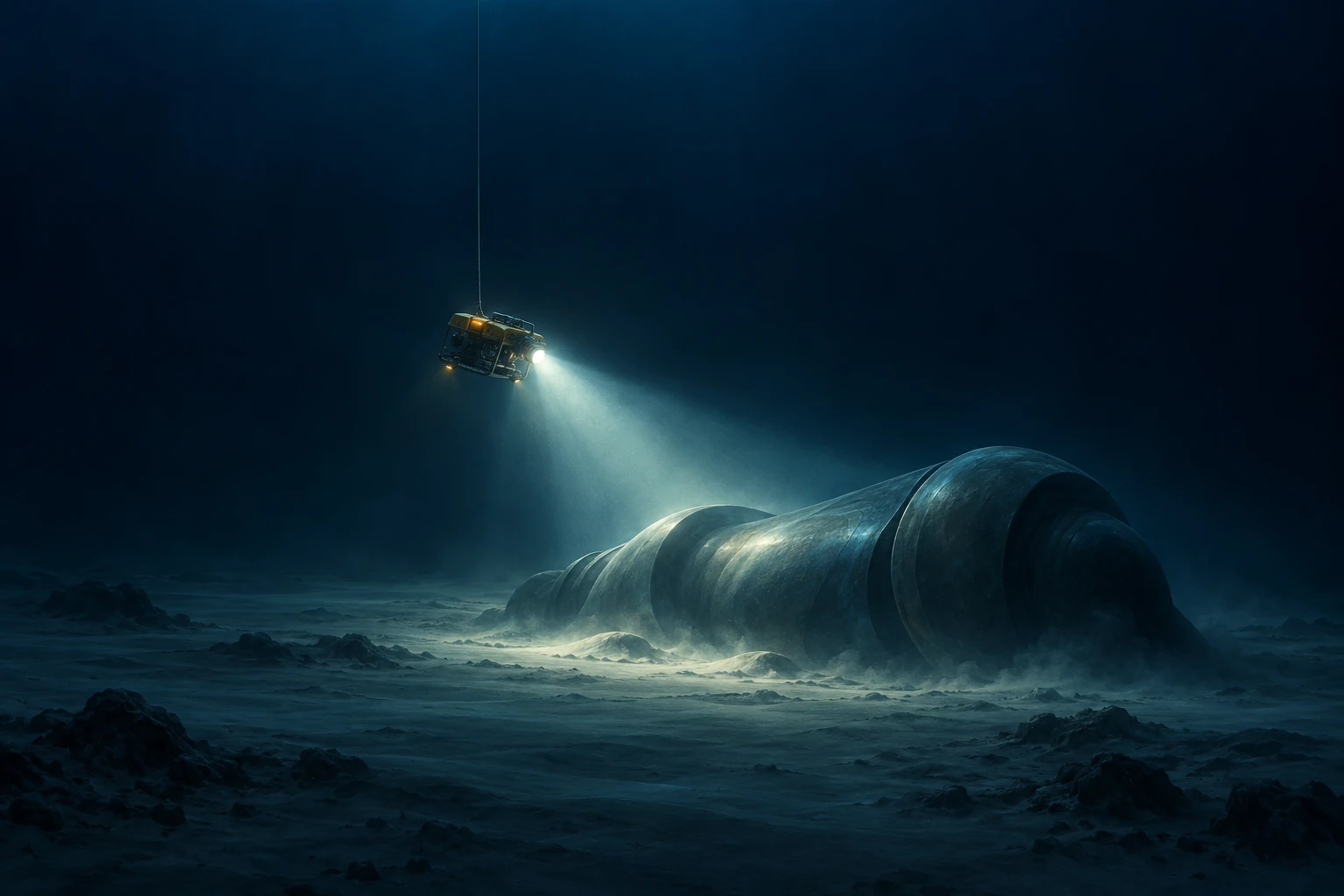
It was still dark outside when the computer chimed. He tabbed away from his videos and back to the live feed, waiting for the ROV’s spotlight to turn on as the machine switched from sonar to computer vision to home in on the debris. He wasn’t needed, but he enjoyed this part: the silted depths of the ocean yielding to show some artefact of humanity’s genius, a star-bound relic rocketed into the firmament and then thrown away like so much litter. He enjoyed watching the craft follow the breadcrumb trail of debris along the seafloor, seeking treasure in the most inhospitable parts of earth. Motes of sediment marked the vessel’s descent, and then it appeared from the darkness.
He didn’t recognise it. It had the look of an engine assembly, perhaps, but no model he knew. It had survived the impact with little deformation, and there seemed to be no debris on the seabed. The longer he looked, the more uncertain he grew. He could see no signs of shearing or splitting, nothing to indicate that the satellite had detached from some larger whole. No rivets or welds. It sat heavily upon the seabed where it had settled. It didn’t look like salvage.
He thought about waking his first mate. If this was some advanced Chinese or Korean prototype, he wanted nothing to do with it. He toggled to the local radar; no vessels within a day. No-one coming to claim this strange thing. It had been four weeks without salvage, and he wasn’t keen on returning empty-handed. He ran the recovery routine. The ROV began to unfold mechanical limbs from within the chassis, deploying harnesses and slings to entrap the crashed vessel, preparing to attach the lifting line to the salvage and begin the slow ascent to the surface. In a couple of hours he would dive down to meet it. If he didn’t like the look of it, he would detach the lifting line and return it to the depths.
As the ROV’s arm draped the object in a thick polyester sling there was a great flash of light. The video feed turned white, and when it returned, the satellite lay in two pieces, cracked neatly into two halves. Even through the video monitor the flash conveyed a feeling of heat, of sterility. A moment later a rattail fish drifted past the camera, listing lifelessly to one side. A warning appeared on screen from the ROV’s umbilical tension monitoring system. The ROV’s lifeline was being subjected to pulses of unexpected force, every second or so. Then a second notification appeared beneath it, from the thruster monitors, reporting that the ROV was firing its thrusters harder than normal to counteract upward drag. A third: the fibre-optic acoustic sensors reporting regular vibrations along the umbilical’s length. There were no cameras along the lifeline, no way to confirm what was happening, but he knew, in spite of all logic and reason. He knew, with certainty, that something was climbing the umbilical, heaving itself upwards. The ROV had taken three hours to descend. How long until this creature surfaced? Far less, he thought. He stood and pushed his chair away. His hands shook.
He met the first mate on his descent to the moonpool, climbing bleary-eyed up the metal staircase to start his morning duties. The first mate heard the clamour of heavy boots above and stood to let the man rush past.
“Where the fuck are you going?”
He clattered through the open door and into the room that housed the moonpool. He made for a tall storage locker and wheeled out the heavy hydraulic cutter. The first mate entered the moonpool bay as he detached the cutting head and began to snake the hydraulic cable along the gangway, to within reach of the submerged vehicle’s lifeline.
“You fucking saboteur. The hell you think you’re doing? Who’s paying you to do this shit?” The first mate paused, waiting for an answer. When none came, he stared into the water, considering. He heard the motors whirring as it pulled the umbilical upwards, inch by careful inch. “What did you find?”
He knew there were no words to explain, no ordering of nouns and adjectives, declarative statements and rhetorical questions, to make the first mate understand the knowledge that had passed through him in an instant. He didn’t want to embroil himself in a pointless debate about cost and reason. Something was climbing the umbilical, and he had to cut it. All else was distraction. He turned away from the first mate and began to secure the cutting head around the thick bundle of cables.
The first mate closed the distance but he was waiting. He dropped the cutting head into the water with a splash and pivoted low, hitting the first mate with a thunderous uppercut that almost lifted him from his feet. The first mate crumpled. He bent down to retrieve the hydraulic cable, pulling the cutting head dripping out of the water. He clamped the cutting head around the umbilical and withdrew as far as the cutter’s cable would allow, sheltering inside the metal tool cabinet, doors pulled up. He hesitated before triggering the actuator; he strode from his shelter and dragged the first mate by his feet to a sheltered corner of the deck where the cable’s whiplash couldn’t reach him.
He triggered the cutting head. Strand by strand it bit through the umbilical’s cables, sending vicious coils of steel and wire and fibreglass whipping around the room in turn. With a final concussive sound the lifeline split and the bulk of the cable whipped away beneath the waters. He knew the Polaris’ backers would kill him for this—but he couldn’t summon any concern. There had been no choice.
After some time he left the tool cabinet and approached the moonpool. He saw nothing but the churning of empty water beneath the ship.
It was dawn by the time the first mate found him, the clear sky blushing with the first hint of morning. He heard shouted words, angry words, empty words that washed over him without registering. He felt the first mate shake him by the shoulder, press the pistol into his back, but he experienced it abstractly, as though at a distance. He stared out to sea, to the empty expanse of waves, the rhythmic swell—to the shower of falling sparks that covered the horizon, hundreds, thousands of unknown satellites leaving orbit to enter the waters of Point Nemo.
It was a matter of perspective, he supposed. From earth, Point Nemo looks like a graveyard. But from space, well—it looks more like an invitation.